Course overview
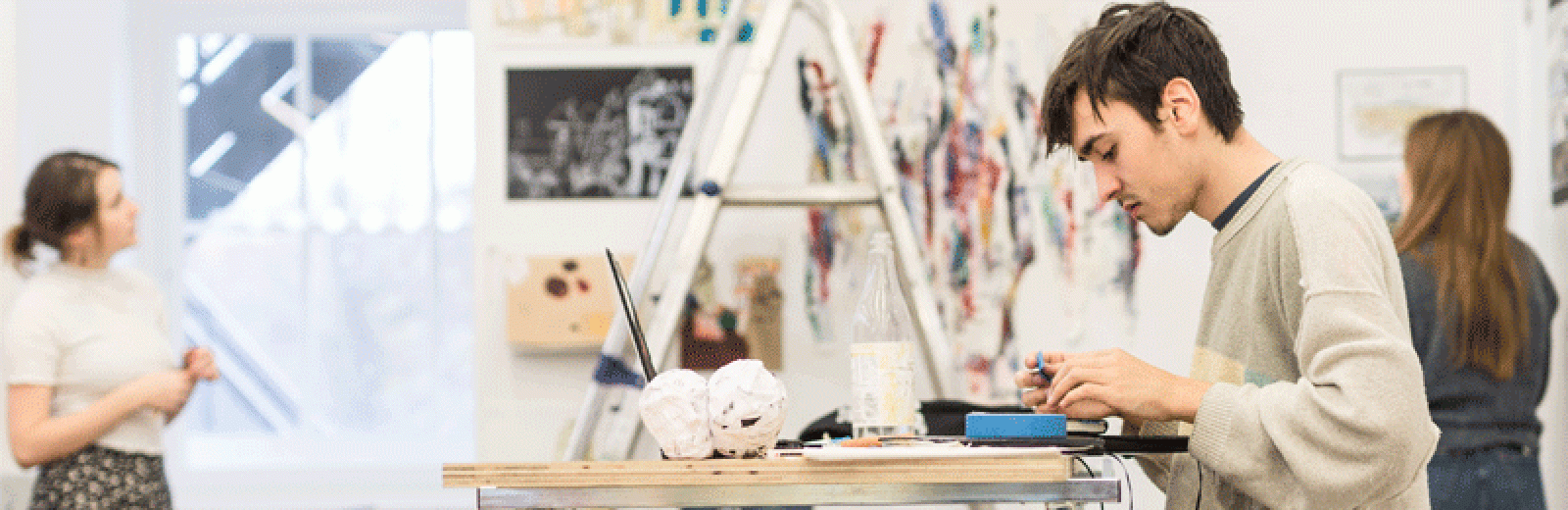
Unlock your self-expression, creativity and critical thinking, as you explore how to solve problems using fresh thinking.
Artists create beautiful, thought-provoking works that resonate emotionally, stimulate conversation and shake cultural norms. These creatives can also turn their talents toward brainstorming fresh ideas, experimenting with innovative approaches, and analysing situations using unique perspectives.
By studying BA Fine Art at Leeds, you’ll explore and challenge your idea of art by engaging with a range of artistic techniques and theories.
You’ll approach the subject as a collection of forms, ideas, and methods for addressing some of the most pressing debates in society today. You’ll explore the relationship between art and social factors that shape our culture, such as ethnicity, class, gender, sexuality, being human and our relationship to nature and the environment.
You’ll become a socially conscious graduate with a range of relevant and transferable skills, like creativity, problem-solving, adaptability and communication. By embracing a diverse set of techniques and practices, you’ll experiment with your creativity and discover your personal style. At every stage of your course, we’ll support you in discovering what kind of creative practitioner you want to be.
I think it’s really lovely to be in a city full of like-minded people, and I feel like it’s an accessible spot for artists because you can exhibit work and get your work out there without having to spend a lot of money.
Why study at Leeds
- Bring your imagination to life: Embrace a multitude of materials and methods as you explore your creativity within your own dedicated studio space.
- Supportive teaching: 100% of students surveyed say staff value students’ views and opinions about the course. (Discover Uni data)
- Your creative community: Exhibit your works, build networks and enrich yourself in Leeds’s thriving art scene.
- Specialist facilities: Practice your skills in our dedicated facilities, like our professionally fitted exhibition space, photography darkroom, and woodworking, casting, and ceramics workshops. Explore our facilities.
- Seek inspiration from the outside: Take part in field trips to art fairs, exhibitions, festivals, and regional museums and galleries.
Course details and modules
Your degree supports you to develop and critically evaluate a personalised approach to contemporary art practice.
The course combines lectures with group seminar sessions, workshop activity and studio-based teaching to explore contemporary art practice and help you contextualise your own creative work. You will have opportunities to engage with contemporary artists, writers, curators and other arts professionals, and gain professional practice experience to help you thrive within the wider art world and creative sectors.
Year 1
From the moment you arrive with us, you’ll be addressed as an emergent artist working as part of a shared community. The 'Introduction to Practice' and ‘Developing Practice’ modules will open up creative possibilities and explore various media and concepts to develop your own creative portfolio. You undertake a range of skills workshops that support your choices for a creative future.
As a Fine Art student, you will be introduced to the key concepts and critical discourses that inform contemporary art practice as viewed from a broad range of cultural perspectives.
Year 2
Now, you’ll think more deeply about being part of a community of artists. You’ll be expected to work with initiative in the studio, to build upon and critically apply the knowledge and skills learned in your first year and further pursue your own individual interests.
Compulsory and optional modules will deepen your understanding of the complex nature of art practices and cultural production. You will continue to develop your individual practice, which will be explored and developed throughout the year.
Open studios and exhibition opportunities will structure your artistic production. By the end of this year, you can opt to take a third-year work placement, study abroad or get ready for your final Degree Show year.
Year 3
In this final year, you will consolidate your individual practice, culminating in planning and organising a public exhibition, the degree show. You will have full authorship of this project, where you can apply your artistic and professional skills. You will be supported to develop your awareness and understanding of the complex and diverse nature of contemporary practice through professional practice activity and self-directed research, consolidating the practical and intellectual skills that you have developed in years one and two. A significant element of your final year is your dissertation, applying your research and critical skills to an independent piece of research on a topic of your choice, which can either complement your art practice or focus on a topic arising from your theoretical study. You can complement and support these projects with a choice of optional modules.
Course structure
The list shown below represents typical modules/components studied and may change from time to time. Read more in our terms and conditions.
Year 1
Compulsory modules
Introduction to Practice (40 credits) - You’ll be given the chance to explore contemporary and traditional approaches to fine art across a range of disciplines, making use of our excellent resources, including, film, experimental printmaking, ceramics, art writing, sculpture, photography and audio-visual practices.
You’ll be introduced into the broader context of contemporary art practices, engaging with artists, tutors and curators through practical studio workshops, live projects and exhibition opportunities. You’ll begin to develop the skills to discuss and analyse contemporary art, as well as deepening your understanding of art history and critical theory.
You'll be introduced to the fundamental skills for developing your own exciting body of work while building critical awareness of the spaces, institutions, social practices and networks in which art is produced and disseminated.
Developing Practice (40 credits) - This module continues with the development of independent studio work for developing self-directed practice-based research, and you will be encouraged to develop artwork that reflects your research interests and locates your work within the contextual framework of contemporary art practice.
You’ll work in self-selected groups as you develop an independent practice and work towards a public presentation of your work.
Ways of Seeing (20 credits) - Taking the act of ‘seeing’ as its starting point, this module asks you to analyse assumptions about art that may appear natural, obvious or unquestionable. By exploring the many ways in which ‘seeing’ is -thought and theorised, you’ll question the relation between society, ideas, art and writing. You’ll consider how visual culture conveys and constructs social values and how ‘seeing’ is wrapped-up with verbal representations and conceptualisations, gaining skills of critical thinking, visual analysis and independent learning in the process.
Ways of Thinking Seeing (20 credits) - Drawing on a wide array of critical art-historical sources and examples from visual culture, this module considers some of the ideological and conceptual structures associated with shaping the process of seeing. Through close reading, you’ll gain an awareness of various categories and structures for seeing, you’ll question notions of ‘meaning’ and ‘interpretation’. Using these ideas as a basis, you’ll develop critical thinking and writing skills to explore, and reflect on, how our lived experience and social relations are shaped by many different, yet interrelated, structures and modes of seeing.
Year 2
Compulsory modules
Defining Your Practice (20 credits) - This module builds on your achievements of the previous year as you take on your own studio in a shared communal space. The emphasis is on independent, self-directed, practice-based research and continuing to address questions of its dissemination, presentation and audience. You’ll develop your work supported by individual tutorials, group crits and technical workshops that allow you to explore the processes and materiality available to realise your creative aspirations.
Practice into Public Contexts (40 credits) - Working in research focused studio groups, you’ll develop a body of work that explores your ideas of audience in relation to appropriate methods of display for your work, building your awareness of the social and cultural contexts, networks and histories that inform contemporary art’s production and presentation.
This module will be supported by individual tutorials and group crits, that continue to support your analytical approach to your own work and that of your colleagues. Specialist workshops will allow you to continue to explore a range of processes, materials and technologies in order to realise your creative aspirations.
Optional modules
Seeing in Asia (20 credits) - Are there fundamental differences between the ways you see familiar objects and those from Asia? Are there ways in which the power and meanings of 'seeing' change in an Asian context, so that even though we are 'seeing' the same object, we understand the object differently? How do cultural and historical values and standards shape the act of seeing and how we interpret images? By engaging with wide-ranging historical and cultural examples drawn from a range of specialities from art to science, this module addresses the age-old problem of ‘nature’ versus ‘nurture’ through the perspective of Asian Culture.
Variant Modernism (20 credits) - Narrative histories of English Art in the 20th century have tended to imply a succession of movements of varying 'modernity'. You’ll look at the different definitions of 'modern' or 'contemporary' art at different historical moments in 20th century England to the present day, as well as studying the underlying critical ideologies. This module will make particular use of the notable collections of Leeds City Art Gallery and the University Collections to understand museological collecting and display policies.
The Grand Tour: Travels, Excavations, Collections (20 credits) - The Grand Tour’s origins lie in the early 17th century, when a small number of British aristocrats left their native islands to explore the cultural capitals of Europe. By the 18th century, it had developed into a rite of passage for privileged young men sent abroad to expand their knowledge of the visual arts, architecture, music and foreign political systems. Its culmination was Rome, where a thriving cultural industry arose to meet the demand for paintings, objet d’art and antiquities. This module will follow a typical Grand Tour itinerary; assess the importance of certain travellers, guides, artists and dealers; explore key publications (some of which are held in Special Collections of the Brotherton Library); and analyse the classification systems and modes of display of major Grand Tour collections in Great Britain and Ireland.
The Art Market: Moments, Methodologies, Meanings (20 credits) - This module introduces some of the main themes in the histories of the art market. It is a chronologically ordered and thematic investigation that focuses on key notions, such as the Primary (production) and Secondary (resale/collecting) art markets, and key segments such as the Fine and Decorative Art ('Antiques') markets. The role of key institutions, such as auction houses and galleries, and key agents, such as art dealers, collectors and artists, are also addressed. You’ll critically reflects on the meanings of some of the dominant tropes associated with those that have traded in art objects, such as the consistent theme of forgery and fakes, as well as the role that the art market plays in the complex nature of the notion of 'value'.
African Art I: Context Representation Signification (20 credits) - This module gives you an insight into African art and the ability to complete a critical assessment of the topic. You’ll understand some of the major issues confronting African art history and will gain knowledge of some of the key aspects of African visual cultures. You’ll also be able to recognise key works of African art.
Bodies of Difference: Gender, Power and the Visual Arts (20 credits) - This module explores a range of feminist, postcolonial and queer theories of the embodiment of gender, its performance, performativity and representation in art and visual culture, showing the relations between the two. You’ll address shifts in the representational schema of the woman's body by the study of a range of feminist perspectives that offer a critical framework for thinking about the body, embodiment and difference in all its intersectional complexity. This module also covers a range of theories and concepts that are vital to our understanding of the power and dynamics of gender and the body that are operative in art history and visual culture. It is in this sense that we will move toward the recent critical feminist theories and art practices that have revisited and challenged the conventions and representations that encoded ‘woman’ as the image of desire.
Renaissance / Anti-Renaissance: Critical Approaches to Early Modern Art in Europe (20 credits) - You’ll engage with several questions fundamental to a critical and historical approach to Renaissance art. Starting with the provocative notion of Anti-Renaissance – explored by the Italian art historian Eugenio Battisti, and in related discussions elsewhere – we will think through the Renaissance as a dynamic site of conflict, contestation and experiment. Against an idea of the Renaissance as the expression of a calm, linear ‘progress’ – towards artistic perfection, towards a rational approach to the world, towards the triumph of the ‘individual’ – notions like Battisti’s enable what is arguably a vital shift of attention to difference, to counter-tendencies, and to the instability, contingency, and even possibly the non-existence, of what are casually accepted as Renaissance ‘ideals’.
Towards the Future (20 credits) - This module provides you with an opportunity to think about the ways in which your knowledge and expertise can be applied beyond your university studies. In order to participate in this module you will need to secure an opportunity to volunteer or work in an external context (such as school education, third sector, or with community groups, or you could use experiences you are gaining through engagement with Leeds University Union). You will be encouraged to consider the relevance of your academic studies and skills beyond Higher Education and to reflect on how framing your studies within an external context can inform your learning and academic practice. This module will support you to reflect on your personal skills development and the ethical implications of working with external partners.
Year 3
Compulsory modules
Practice towards exhibition (60 credits) - In this module you’ll continue to develop your research driven creative practice to produce a highly consolidated body of work and apply critical skills to its presentation. By the end of the module, you’ll have gained advanced technical skills in your chosen media and a highly critical understanding of contemporary art practice and its history. The focus is towards the public platform of the degree show exhibition. In addition to exhibiting, you’ll have the opportunity to volunteer on the curatorial organising group and to gain invaluable experience of planning and delivering a large-scale group exhibition. Our artistic community has full authorship of their degree show, while being supported by our specialist technicians, academic staff and the University marketing team.
Dissertation (40 or 60 credits) - The aim of a dissertation is to foster your own independent research and scholarship alongside your studio practice, by identifying appropriate critical, historical and theoretical frameworks for your chosen subject. Your project is supported by a dedicated dissertation supervisor, who is aligned to your research interests. You might use this arts-based research opportunity to further your own practice concerns, helping you to address critical cultural questions, or material concerns, future practice options or to identify new forms of knowledge that will support you in your future career plans or to launch further study in an MA or similar further postgraduate study programme.
Optional modules
If you choose the 40 credit Dissertation option, you will be able to take one 20 credit Optional Module.
From Trauma to Cultural Memory: The Unfinished Business of Representation and the Holocaust (20 credits) - This module addresses debates in literary, historiographical and psychological theory about the ways in which witnesses provide testimony, and the ways in which the legacy of a historical trauma of the magnitude of the Holocaust is represented by historians, sociologists, writers, artists and museums. Rather than an historical study of the events of 1933-45, you’ll consider the continuing significance of this disaster in the larger context of European history. You’ll pay close attention to the voices and images of those who continue to live with a trauma that only psychological, analytical, creative work can turn into memory, which the cultures of Europe must take on as the history that continues to shape our present responses to all forms of racism, genocide and violence against the stranger.
Cultural Diversity in Museum and Material Culture - Case Study (20 credits) - Museums are increasingly conscious of the need to be socially inclusive. Traditional models of privileging high art and 'white western' art have come under sharp criticism. On this module, you’ll examine how museums have integrated (or failed to do so) the artefacts of the Jewish minorities in Europe and the USA. You’ll look at the historical reasons for the omission of Jewish culture from many museums, and the particularities of the models adopted for Jewish museums and Jewish exhibits in ethnographic and local history contexts.
Anthropology, Art and Representation (20 credits) - The anthropology of art has long been a fertile and vital area of contention around cultural value and cross-cultural relationships. It has not been merely an academic area of enquiry, but one caught up in the debates and controversies in the public sphere, about museums exhibitions. In addition, the anthropology of art provides a comparative perspective on the way in which art is represented in the west. The issue of cultural representation is therefore of crucial importance to an understanding of the way in which Euro-American interacts with the rest of the world. You’ll examine specific objects and "texts", and their interpretation, in relation to larger questions concerning gender, embodiment, technology and representation.
Unmaking Things: Materials and Ideas in the European Renaissance (20 credits) - This module will attend to a series of questions generated by historical consideration of the materials from which Renaissance artworks and objects were made. With a focus on Europe (though in several ways thinking about European encounters with other cultures), we will develop approaches that cross between close object-analysis and critical reflection on some of the broader social, political, religious and philosophical frameworks in which ideas of materiality took shape in this period. You’ll look at primary written sources and think about a broad range of objects and materials. We will pursue ways of ‘unmaking’ the ostensibly settled and self-contained appearance of Renaissance objects, and of positioning them as active engagements within dynamic, and often conflicting, cultural tendencies.
Critical Approaches to Photography (20 credits) - Photographic images saturate every corner of contemporary society in a developed country to such an extent that it is difficult to spend a day without seeing a photographic image. Yet, the popular concepts in discussions of photography remain overused and unexamined at best ('truth' 'reflection' 'index'). By engaging with historical and cultural treatises about the medium and its property (how photography 'reflects' reality, how photographers 'see' differently, for instance) this module excavates the multiple layers of philosophical issues embedded in concepts such as 'truth,' 'reality' and 'mediation' in thinking about and writing about photographic images.
Postcolonial Feminisms (20 credits) - You’ll examine feminist theory and politics, as they have developed in the context of the period of decolonization and its wake. Emphasis will fall on theoretical formulations concerning sexual difference and the social division of gender as these have been produced by women writing to or from former European colonies. Attention will also be given to questions posed by and for feminism within postcolonial metropoles.
Antique Dealers: The Market for 'Decorative Art' from Curiosities to Retro (20 credits) - You’ll pay critical attention to the history of the 'modern' antiques ('Decorative Art') trade, from its development in the early 19th century to the present day. You’ll get an introduction to some of the main themes in the histories of the market for antiques through a chronologically ordered and thematic investigation focused on key notions and practices, placing these into their social, cultural, economic and political contexts. The focus begins with a critical investigation on the shifting meaning of the notion of 'antiques' and the development of related terms such as 'curiosities' and 'bric-a-brac', as well as the emergence of more recent notions such as 'vintage' and 'retro'. The focus of the module is on the history, role, and practices of 'antique dealers', and introduces you to some of the most important dealers and their histories, placing the dealers into the context of the history of the market for 'antiques' more generally. The module also critically reflects on the meanings of some of the dominant tropes associated with those that have traded in art objects, such as the consistent theme of forgery and fakes in the biography of the antique dealer, as well as directing attention to the portrayal of the antique dealer in both factual discourse and fictional representation (visual and literary).
Africa and the Atlantic World: History, Historiography and the Visual Arts (20 credits) - This module is about aspects of the visual arts of the region south of the Sahara, mostly from Congo/Zaire through West Africa to the Atlantic coast, and to the Americas. It explores episodes with which one might begin to write a history of contemporary sub-Saharan African art. Three themes dominate the module:- First, there is the relationship between antiquity and the modern world, the ways indigenous achievement provided the basis for aspects of change and development characteristic of the period to the end of the 19th century. Second, there is the relationship between 'tradition' and the 20th/21st century, when colonial and primitivist stereotypes are challenged through developments in art and other areas of social practice. Third, we look at what happens in the African diasporas: what survived the Middle Passage, 'Africa' as a source of new identity.
Movies, Migrants and Diasporas (20 credits) - This module is dedicated to migration and diaspora in Europe as reflected in the cinema. It introduces you to the work of filmmakers with, for example, German Turkish, Black or Asian British, Maghrebi French, Roma or Jewish backgrounds, productions made by transnational Eastern European practitioners and films about migration and diaspora created by non-migrant/diasporic writers and directors.
Learning and teaching
Learning and teaching is delivered within a collective community environment, where shared interests and aims can be explored to embrace an inclusive sense of belonging and ownership. Mutual support and collaboration are openly encouraged.
Studio tutors are practising artists, writers and curators who are contributing to national and international exhibitions and publications. Their research informs and contextualises your learning and teaching.
This course combines studio, exhibition and curatorial work with traditional teaching and learning methods such as lectures, seminars, studio crits, tutorials and workshops. You’ll also have the chance to enhance your knowledge and learning by attending talks from nationally and internationally renowned visiting artists and creative practitioners, as well as attending exhibitions and conferences both on and off campus.
Independent study is a vital element of this degree, allowing you to develop your creativity and build important skills in areas such as research, analysis and interpretation. We encourage you to carry out small research projects, on your own or as part of a group. The final year dissertation enables you to undertake substantial independent research in a topic of particular interest to you.
Our creative community
You’ll get the chance to contribute to the creative community, build networks in the city and exhibit your work regularly.
We champion a School-based artist community ethos by providing shared studio space with regular open studio and exhibition events, informal learning groups, opportunities for student-led social events and access to the city’s artistic scene.
You’ll work alongside art historians and cultural theorists within a purpose-built School that includes studios, technical workshops, a project gallery, seminar rooms and a shared student common room.
Our course also offers you a range of opportunities to experiment across different media and undertake original research. You’ll may also build broader skills in curating, event production, critical thinking, writing, researching, publishing and media content production. You can then put these skills into practice through regular exhibition opportunities.
We organise field trips to art fairs, exhibitions and festivals, and regional museums and galleries across all levels. Our exemplary Year in Industry programme has led to students successfully undertaking work placements in the UK and internationally, some of which have led to permanent employment in the arts sector. Additionally, you can engage in our Study Abroad programme, which has provided life-changing experiences for many within our student community.
Specialist facilities
The School has excellent facilities and resources, including:
- the Project Space – a professionally fitted exhibition space, suitable for all media
- dedicated Mac and PC computer suites for audio production, video editing animation and image manipulation
- printmaking workshops for etching, relief and screen printing
- a photography darkroom for film developing and printing
- casting and ceramics workshop, including kiln facilities
- a woodworking area
- digital and 3D printing
In addition to the wide range of museums and galleries in the city and beyond, the University campus features:
- The Stanley & Audrey Burton Gallery
- Treasures of the Brotherton Gallery
- Museum of the History of Science, Technology and Medicine
- M&S Archive
- International Textile Collection
- Public art trail
- stage@Leeds Theatre
- Clothworkers Hall music venue
- Leeds University Union events
The University Library offers online books, journals and databases, has a wealth of archive material in its Special Collections, including manuscript, archive and early printed material, and provides a range of spaces for individual study or group work. You’ll also benefit from access to Box of Broadcasts, an archive of over 2 million TV and radio broadcasts.
Programme team
On this course, you’ll be taught by our expert academics, from lecturers through to professors. You may also be taught by industry professionals with years of experience, as well as trained postgraduate researchers, connecting you to some of the brightest minds on campus.
Assessment
We use a combination of assessment methods that allows you to develop diverse skills. These include your studio work, essays and exams, depending on the modules you have selected to study.
Assessment is led by principles of relevance, fairness and inclusivity, and the development of vital skills beyond university, such as problem solving, adaptability, self-reliance and reflexivity.
Practice modules, across the three years of study, are assessed by the submission, at the end of each module, of a single PDF portfolio and supporting statement.
Entry requirements
A-level: ABB
Other course specific tests:
Where an applicant is undertaking an Extended Project Qualification (EPQ), the School may make an alternative offer that is one A level grade below that of our standard offer – on the condition that the applicant achieves a grade A in their EPQ (e.g. ABB at A level / alternative offer BBB plus grade A in EPQ).
NB: An EPQ is optional and not a requirement of application.
Applicants already studying a Fine-Art related subject at Level 3, or undertaking Access to Leeds (please note you must meet the criteria for this) will not be required to submit a portfolio.
Applicants who are not taking a Fine-Art related subject at Level 3 will be required to submit a satisfactory portfolio of work.
Alternative qualifications
Access to HE Diploma
Pass with 60 credits overall including 45 credits at Level 3, of which 30 credits must be at Distinction and 15 must be at Merit level.
BTEC
DDM
Example combination offers:
Distinction in BTEC Extended Certificate/Subsidiary Diploma plus BB in two A Levels or Merit in BTEC Extended Certificate/Subsidiary Diploma plus AA in two A Levels
Distinction Distinction in BTEC Diploma plus C at A Level or Distinction Merit in the BTEC Diploma plus A at A Level
Cambridge Pre-U
M1, M1, M2
International Baccalaureate
34 points overall including 16 at Higher Level with 4 in English
Irish Leaving Certificate (Higher Level)
H2, H2, H2, H3, H3, H3
Scottish Highers / Advanced Highers
Welsh Baccalaureate
WJEC Level 3 Advanced Skills Baccalaureate Wales is accepted in place of a third A-level subject at the same grade.
For example: we require two A-levels at grade AB, plus your Level 3 Advanced Skills Baccalaureate Wales at grade B. (excluding General Studies and Critical Thinking)
Other Qualifications
Art Foundation Diploma: Merit or higher with A-level: Grade A (any subject considered other than Critical Thinking or General Studies).
UAL Extended Diploma: Distinction (or High Merit where available).
European Baccalaureate: 75%
Read more about UK and Republic of Ireland accepted qualifications or contact the School’s Undergraduate Admissions Team.
Alternative entry
We’re committed to identifying the best possible applicants, regardless of personal circumstances or background.
Access to Leeds is a contextual admissions scheme which accepts applications from individuals who might be from low income households, in the first generation of their immediate family to apply to higher education, or have had their studies disrupted.
If you live in a neighbourhood where there is low participation in higher education, we may be able to give priority to your application.
Find out more about Access to Leeds and contextual admissions.
Arts and Humanities with Foundation Year
This course is designed for students whose backgrounds mean they are less likely to attend university (also known as widening participation backgrounds) and who do not currently meet admissions criteria for direct entry to a degree.
The course will give you the opportunity to be taught by academic staff and provides intensive support to enable your development of academic skills and knowledge. On successful completion of your foundation year, you will progress to your chosen degree course. Find out more about the Arts and Humanities with Foundation Year
International
We accept a range of international equivalent qualifications. Contact the Undergraduate Admissions Office for more information.
English language requirements
IELTS 6.0 overall, with no less than 5.5 in any component. For other English qualifications, read English language equivalent qualifications.
Improve your English
If you're an international student and you don't meet the English language requirements for this programme, you may be able to study our undergraduate pre-sessional English course, to help improve your English language level.
Fees
UK: £10,050
International: £27,300 (per year)
The amount of tuition fees you pay is based on whether you are classified as a home (UK) or international student. Find out how we assess your fee status.
Tuition fees for UK students
Tuition fees for UK undergraduate students starting in 2027/28 are £10,050.
Subsequent years
The UK government sets the maximum tuition fee caps that universities can charge UK students. This means your tuition fee in future academic years will reflect any changes set by the government.
From 2028/29 onwards, tuition fees are likely to increase annually, at least in line with inflation, and may rise further if the government increases the fee cap.
Tuition fees for international students
The international fee applies for each year of full-time study and will remain the same for the duration of your course.
Read more about tuition fees.
Tuition fees for a study abroad or work placement year
If you take a study abroad or work placement year, you’ll pay a reduced tuition fee during this period. For more information, see Study abroad and work placement years on our tuition fees page.
Additional cost information
There may be additional costs related to your course or programme of study, or related to being a student at the University of Leeds. Read more on our living costs and budgeting page.
Scholarships and financial support
If you have the talent and drive, we want you to be able to study with us, whatever your financial circumstances. There is help for students in the form of loans and non-repayable grants from the University and from the government. Learn more about undergraduate funding.
Scholarships are also available to help fund your degree. Find out more and check your eligibility below:
Applying
Apply to this course through UCAS. Check the deadline for applications on the UCAS website.
Digital portfolio
Applicants already studying a Fine-Art related subject at Level 3, or undertaking Access to Leeds (please note you must meet the criteria for this) will not be required to submit a portfolio.
Applicants who are not taking a Fine-Art related subject at Level 3 will be required to submit a satisfactory portfolio of work.
What is a digital portfolio?
A digital portfolio is a PDF file that shows images of your artwork alongside notes, research and any relevant writing.
It’s your opportunity to show us the work you have been making, what you are interested in, and how you explore ideas and creative processes and materials.
Why do I need to submit a portfolio?
Submitting a portfolio helps us understand what inspires you, what you care about, and how you use different materials and techniques to bring your ideas to life.
What should I include in my portfolio?
Show us the work you're most excited about—this can be work done at school or college or work you've done independently.
Show us different media you have used - drawings, collages, paintings, prints, assemblages, installations, sculpture, photography, film, animation, pages from sketchbooks, documentation of performances—whatever best represents you.
Pick pieces that reveal your creative process, interests, and willingness to experiment. You can also include unfinished pieces.
5–6 strong pieces can highlight your range, but there’s no set number.
Feel free to include writing—like personal statement excerpts that show your passion for art and why you're motivated to study Fine Art.
When we look at your portfolio, we will consider 4 key areas:
Methods: Show us examples of work you have created using different methods of making. This could include experimenting with different materials, processes and technologies. Show us how you have tested different methods of thinking and making.
Contexts: Show us how your work connects to the world around you and your personal experiences. If you’ve shown your work somewhere, tell us why that space mattered. If there are references from contemporary art or art history, exhibitions, film, reading material and literature that are important to you, share them with us.
Research: Show us how your ideas take shape. Share sketches, tests, unfinished work—even the work that didn’t go to plan. Let us see how you explore through making, reading and researching. Add notes or captions to explain what you were thinking and what you discovered.
Presentation: Pick clear, well-lit photos that show off your work. Think about the order of your images—tell a story with them. Use close-ups to highlight textures and details, and feel free to show different angles of the same piece.
Can I see an example portfolio?
View an example portfolio here (PDF)
Portfolio checklist:
Your portfolio should be a single PDF with a maximum document size of 30MB.
Include a cover page that contains your full name and the course you’re applying for.
Your portfolio can contain up to 10 pages, including the cover page. Multiple images can be on a single page but do make sure we can clearly see the work.
If you are working with moving image, you can include links to videos on platforms like YouTube or Vimeo. Make sure you include a full URL for any links and provide any passwords for access. Moving image works should be single works, not video versions of other supporting material or showreels of multiple works
Make sure to include captions for all your images. These should include the title, year, materials used and the size of the work. Here is an example of an image caption:
Imprint sequence, 2026, intaglio etching on paper, 24 x 52cm
The portfolio is mainly a visual document, but you can also include short notes and other extracts of writing that support your work. 200-300 words is a helpful word count to keep in mind, and can be included as either a single paragraph or smaller sections of writing alongside your images. Expanding your image captions is one way of doing this.
How do I submit my portfolio?
After you apply, we will contact you to let you know how to submit your portfolio and give you a date to submit this by.
If you have questions about your portfolio, please contact our Admissions Team via email at finadm@leeds.ac.uk who will be able to help.
What happens next?
After you have submitted your portfolio, you should expect to receive an offer decision via UCAS Track within three to four weeks of submission. If you do not, please contact our Admissions Team via email at finadm@leeds.ac.uk to make further enquiries, making sure you quote your name, course and UCAS ID number.
Read further guidance about applying to this course.
International students apply through UCAS in the same way as UK students. Our network of international representatives can help you with your application. If you’re unsure about the application process, contact the admissions team for help.
Read about visas, immigration and other information in International students. We recommend that international students apply as early as possible to ensure that they have time to apply for their visa.
Admissions policy
University of Leeds Admissions Policy 2027
This course is taught by
School of Fine Art, History of Art and Cultural Studies
Contact us
School of Fine Art, History of Art and Cultural Studies Undergraduate Admissions
Email: finadm@leeds.ac.uk
Career opportunities
We’re committed to enhancing student employability and embedding you with transferrable skills that you can apply to a range of careers. Many of our graduates become ambitious and pioneering artists, curators, critics, journalists and innovative founders working across a wide array of creative fields.
Our graduates combine careers as artists with work in education, museums and galleries and art therapy. They have established new cultural enterprises, including The Tetley, a contemporary art space in Leeds. Others use their knowledge and skills to launch careers in a variety of fields, including journalism, broadcasting, marketing, technology, business or design.
You may also decide to pursue postgraduate study, including programmes in fine art, curating and museum studies, arts marketing, art and business, art and design PGCE, interactive design, gaming, animation and art and ecology.
Many have completed PhDs and teach in higher education institutions worldwide. As a School, we have an engaged research community comprising MA and PhD students working across fine art practices, art history, cultural studies, gallery, museum and heritage studies.
Where this degree could take you
Here’s an insight into the job roles some of our art graduates have obtained:
- Editorial Designer, American Planning Association
- Founder and Director, East Leeds Project
- Junior Creative Strategist, BISQIT
- Educational consultant, Bonas Macfarlane
- Fine Art Consultant, Castle Fine Art
- Project Manager, Elegant Clutter
- Video Editor, MVF UK
- International Relations Manager, pop-off-art gallery
- Assistant Curator, The Magnes Collection of Jewish Art and Life
Top 10 most targeted for 10+ years
by the UK's leading employers
Careers support
At Leeds, we help you to prepare for your future from day one.
Our Careers Service has the global expertise and sector-spanning industry partnerships that, combined, go well beyond simply helping you get a job. They provide you with the resources you need to upskill and achieve the future you aspire towards – even in the face of lightning-paced change.
- Dedicated Employability Team: Meet with our qualified careers consultants and specialist employability and placements officers, on hand to help you choose the right path and develop the skills to get there. They can support with CV and cover letter writing, LinkedIn profile building, mock interviews and navigating AI: get confident with tailored advice and techniques.
- Employability and networking events: Get involved in a full range of events, including careers fairs and specialist industry talks with employers who are actively recruiting. You’ll also benefit from mentoring and a supportive careers community, helping you make connections, build your network, and shape your journey as a future professional.
- Skills training: We embed transferable skills training in all our programmes to support your transition to the workplace. Gain expertise employers value, such as communication, problem-solving and research and data analysis.
- MyCareer system: Access a dedicated portal where you can book careers appointments, view helpful resources and browse vacancies and events. Access digital tools, including LinkedIn support, video‑interview preparation, plus global job market and visa guidance. We also offer pre‑arrival support to help you prepare for career planning in the UK and make the most of your time with us.
- Exclusive opportunities: Bring your enterprise to market with our award-winning business advice service, Spark. Apply for vacancies only available to our students. And hone your skills further with Leeds University Union, home to volunteering opportunities and over 300 clubs and societies.
Study abroad and work placements
Study abroad
On this course, you can apply to study abroad, usually as an extra academic year. We have over 300 University partners worldwide and popular destinations for our students include Europe, the USA, Canada, Australia, New Zealand, Singapore, Hong Kong, South Africa and Latin America.
Work placements
Make connections, practice skills and build future confidence in your future with an industrial placement year as part of your course.
A work placement can be a great investment in your future:
- Choose from 100+ organisations in the UK and overseas.
- Build industry contacts within your chosen field.
- Be in direct contact with potential employers thanks to our close industry links.
- Advance your experience and skills by putting course teachings into practice.
- Gain invaluable insight into working as a professional in your chosen industry.
- Improve your employability.
- All placements sourced by the University are paid positions
- We also offer shorter-term placement opportunities.
Our Employability Team are here to help you every step of the way. They run several placement sessions to answer your questions, discuss available opportunities and support you with CV writing and interview preparation.
If you decide to undertake a placement year, your period of study will be extended by 12 months.
If your application is successful, during placement, you'll be supported by an industrial supervisor from within the company, plus an academic supervisor who will keep in touch throughout.
On successful completion of your placement year, you'll be awarded the ‘industrial’ variant in your degree title to demonstrate your added experience to future employers.
Students in our Faculty have recently completed placements at:
- The Walt Disney Company
- SXSW London
- Virgin Media O2
- Fantastic Media
- L'Oreal
- Adobe
- Porsche
We can’t guarantee a work placement. The job market is competitive – and there may be competition for the placement you want. You’ll have to apply the same way you would for any job post, with your CV and, if successful, attend an interview with the organisation. That said, we encourage everyone to apply.