Course overview
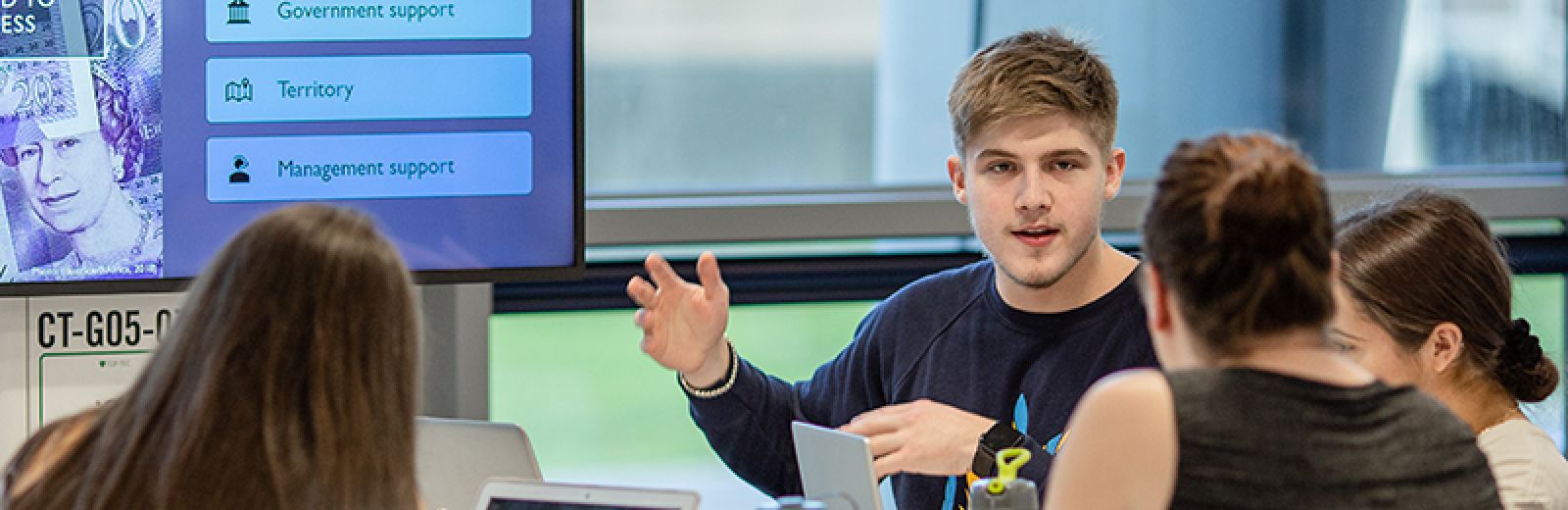
Learn the economics of the firm: how to practically apply economics to boost business and build a promising career.
Our BSc in Business Economics offers flexible study in organisational economics, with less emphasis on mathematics than our other economics courses. In practice, that means you’ll spend more time exploring concepts, practices and techniques, alongside gaining analytical, quantitative, computing, presentation and other transferable skills.
Businesses are up against an ever-increasing pace of change, making economic experts increasingly critical. In our challenging and supportive environment, you'll develop an in-depth understanding of the nature and methods of economic analysis. That way, you’ll be able to analyse individual behaviour, firm strategy and interactions, the wider economic environment, and policy options and dilemmas.
You’ll be able to tailor your degree too. Optional modules include project appraisal, behavioural economics, environmental economics, macroeconomic policy, international trade, and health. Wherever you see yourself making an impact, we’ll prepare you to compete for and succeed at all kinds of exciting careers in companies and institutions based in the UK and globally.
Why study at Leeds?
- Prestigious triple accreditation: Our Business School is triple-accredited, and this course is supported by a partnership with the CQF Institute, the awarding body for the Certificate in Quantitative Finance (CQF).
- Your course, your choice: Pathways give you the chance to hone your skillset to suit career goals in Business Management, International Business, Enterprise and Innovation, and Ethics and Sustainability.
- Connect with leading experts: Network with guest speakers from industry and politics at our ‘Meet with the Economists’ series. Featuring debates, discussions and presentations, you can develop your professional communication skills and gain insights for your future career.
- Study in a city of industry: Leeds is an economic hub, home to the Bank of England, Sky, PwC, NHS Digital and KPMG. Our relationships with industry translate directly into opportunities for our students.
- Explore global perspectives: Benefit from our pluralist approach that’s grounded in the real world to gain insight into varying economic perspectives.
- Develop practical understanding: Gain the practical data analysis skills graduate employers look for, using data and software to understand and solve real-world economic problems.
Why study Economics at Leeds University Business School?
Viewing this page in China? Watch on Bilibili.
Accreditation
Course details and modules
Our degrees have a modular structure. This means that the theoretical and applied content within our compulsory modules provide you with the core knowledge and skills that you need.
Alongside these compulsory modules, you’ll also have the opportunity to shape your course through optional, pathway and discovery modules. They’re a great way to tailor your study around your interests or career aspirations and help you stand out in a competitive graduate job market.
- Optional modules are related to the field of business economics enabling you to deepen your knowledge and skills within this area.
- Pathways are optional modules which you can study in your second and final year. These are themed around key business disciplines, designed to complement your core knowledge and skills in business economics and broaden your expertise. You can choose to study modules from up to two pathways during each year, with the opportunity to continue, choose a different pathway* or return your focus to optional business economics modules as you progress between years.
- Discovery modules give you opportunities to expand your intellectual horizons outside your subject area. They are categorised into Discovery Themes ranging from arts to sciences, and from theory to practice.
Whether you choose optional, pathway or discovery modules, you’ll be shaping your course to suit your personal interests and career aspirations. In all years, you will be able to choose from a selection of modules that reflect the research interests and expertise of staff at Leeds.
*Subject to prerequisites in year 2.
Year 1
You will gain a solid foundation in economic theory and the mathematical and statistical tools to support the rest of your studies. During year 1, you’ll also develop your academic, research and professional skills. You’ll have the opportunity to explore economic issues in more depth through your choice of optional modules or you can choose to study other subjects through discovery modules from the wider University.
Year 2
In the following year you’ll build on and enhance your understanding of microeconomics, macroeconomics, industrial organisations and business economics. Throughout year 2, you will develop skills to carry out your own research. Optional modules will allow you to focus on topics including labour economics, project appraisal, transport, trade, and ethics. You’ll also have the option to broaden your study of business economics through pathway modules, covering topics such as entrepreneurship, ethics and sustainability, international business and business management. A choice of discovery modules will also be offered.
Final year
In your final year, you will deepen your understanding of the strategies that businesses and corporations use. You will also be able to choose from a diverse list of optional modules, for example economic development, monetary economics, behavioural economics, microeconomics and macroeconomics. A choice of pathway modules covering topics such as strategic management, European business, enterprise and entrepreneurship and ethical business will also be available, in addition to a selection of discovery modules. You’ll apply the knowledge and skills you have gained through completion of a dissertation on a topic of your choice.
Course structure
The list shown below represents typical modules/components studied and may change from time to time. Read more in our terms and conditions.
Year 1
Compulsory modules
- Academic, Professional and Research Skills for Studies in Economics (20 credits)
- Mathematics and Statistics for Economics and Business 1B (10 credits)
- Economics and Global History (10 credits)
- Economics Perspectives and Controversies (20 credits)
- Economic Theory and Applications (30 credits)
Optional modules
- Mathematics and Statistics for Economics and Business 1A (10 credits)
- Institutions of Work and Employment (10 credits)
- Institutions of Growth and Regulation (10 credits)
- Organisational Behaviour (20 credits)
- Starting Your Own Business (10 credits)
Year 2
Compulsory modules
- Intermediate Microeconomics (10 credits)
- Industrial Economics (10 credits)
- Economics Research Methods (10 credits)
- Statistics and Econometrics (20 credits)
- Business Economics (10 credits)
- Intermediate Macroeconomics (10 credits)
Optional modules
- Introduction to Health Economics (10 credits)
- From Study to Work (10 credits)
- The Evolution of Economic Ideas (10 credits)
- Mathematics for Business and Economics 2 (10 credits)
- Macroeconomic Policy and Performance (10 credits)
- International Economics (10 credits)
- Labour Economics (10 credits)
- Ethics and Economics (10 credits)
- Transport Economics (10 credits)
- Project Appraisal (10 credits)
- Experiencing the World of Work (10 credits)
Pathway modules
Business and Management pathway
- How Managers Make Decisions (10 credits)
International Business pathway
- Small Business Internationalisation and Growth (10 credits)
Enterprise and Innovation pathway
- Entrepreneurship in Theory and Practice (10 credits)
- New Enterprise Planning (20 credits)
Ethics and Sustainability pathway
- Leadership Ethics (10 credits)
- Contemporary Industrial Relations (10 credits)
- Corporate Social Responsibility (10 credits)
Year 3
Compulsory modules
- Economics Dissertation (40 credits)
- Economics of Business and Corporate Strategy (20 credits)
Optional modules
- Introduction to the Economic Evaluation of Health (10 credits)
- Advanced Microeconomics (10 credits)
- Contemporary Issues in Economic Growth (10 credits)
- Economic Development (20 credits)
- Environmental Economics (10 credits)
- Applied Econometrics (10 credits)
- Behavioural Economics (10 credits)
- Modern Theories of Money and Monetary Policy (10 credits)
- Public Enterprise and Regulation (10 credits)
- Advanced Macroeconomics (10 credits)
- International Economics: Integration and Governance (20 credits)
- The Political Economy of Work (10 credits)
- Behavioural Science in the Contemporary Workplace (10 credits)
- Applied Mathematical Analysis for Economics and Finance (10 credits)
Pathway modules
Business and Management pathway
- Contemporary Issues in Strategy (10 credits)
- Current Issues in Decision Making (10 credits)
International Business pathway
- International Business Management (20 credits)
- European Business (10 credits)
- Transnational Corporations in the World Economy (10 credits)
Enterprise and Innovation pathway
- Critical Perspectives in Enterprise and Entrepreneurship (20 credits)
- Innovation in Practice for Change and Impact (20 credits)
Ethics and Sustainability pathway
- Gender and Equality at Work in Comparative Perspectives (20 credits)
- Diversity Management (20 credits)
- Sustainable Business Futures: Policy and Practice (20 credits)
- Ethics of Artificial Intelligence (10 credits)
Learning and teaching
You’ll be taught using a range of methods including lectures, tutorials, seminars and workshops. The rest of your time will be spent in independent learning, which allows you to develop your skills in research and analysis. Our Virtual Learning Environment will help to support your studies: it’s a central place where you can find all the information and resources for the School, your course and modules.
On this course, you’ll be taught by our expert academics, from lecturers through to professors. You may also be taught by industry professionals with years of experience, as well as trained postgraduate researchers, connecting you to some of the brightest minds on campus.
Assessment
We use a variety of assessment methods to help you develop a range of transferable skills that you’ll need in professional life. These are likely to include coursework, exams, oral presentations, group reports and a dissertation.
Specialist facilities
At Leeds University Business School, you’ll have access to specialist facilities including state-of-the-art lecture theatres, collaborative learning and teaching spaces with the latest interactive technology and modern study spaces with dedicated computer clusters. Read more about our Business School facilities.
Explore more of our facilities through our 360 virtual experience.
Entry requirements
A-level: AAA
GCSE: Applicants must demonstrate a broad general education with acceptable levels of Literacy and Numeracy, including Mathematics grade A/7 and English Language grade B/5 or equivalent, or an appropriate English language qualification. If you have a B/5 in GCSE English Literature, we will accept a Grade C/4 in GCSE English Language.
Other course specific tests:
Read more about UK and Republic of Ireland accepted qualifications for this course.
Alternative qualifications
Access to HE Diploma
The Access to Higher Education Diploma is assessed on a case-by-case basis upon receipt of the application. We can consider this qualification from UK applicants only, who must complete a Business-related diploma of 60 credits to include 45 credits at Level 3. A minimum of 30 Level 3 credits must be awarded at Distinction and 15 at Merit.
Applicants are expected to meet the GCSE Mathematics and English Language minimum requirements for their chosen degree programme.
BTEC
Applicants declaring a BTEC National Extended Diploma in Business or Enterprise and Entrepreneurship or Marketing must achieve Distinction* Distinction Distinction (an A-level is not required).
For other BTEC qualifications alongside academic A-levels, please see our BTEC entry requirements.
Cambridge Pre-U
D3, D3, M2 or D2, M1, M1.
Please note that this requirement excludes the Cambridge Pre-U Certificate in Global Perspectives and Independent Research. We also consider applicants who declare a combination of Pre-U and A-Level qualifications. Please contact lubsugadmissions@leeds.ac.uk for further advice.
International Baccalaureate
35 points overall with 17 points from Higher Level subjects. Plus Mathematics can be met via a 5 at Standard Level or a 4 at Higher Level. English Language can be met via a 5 at Standard Level or Higher Level English A, or a 7 at Standard Level English B, or a 6 at Higher Level English B.
For those applicants who meet our Mathematics or English Language requirements through another qualification, these minimum points for Mathematics or English Language in the International Baccalaureate Diploma do not apply.
Literature and Performance or English ab initio are not accepted for English Language, and a separate English Language qualification is required.
Irish Leaving Certificate (Higher Level)
Applicants must achieve six H2 grades in the Irish Leaving Certificate (Higher Level).
Mathematics and English Language will be accepted at Ordinary level in lieu of GCSEs. A grade of O2 is required for GCSE A/7, (Mathematics). A grade of O3 is required for English Language.
Scottish Highers / Advanced Highers
Scottish Highers and Scottish Advanced Highers are acceptable for entry onto our degree programmes in the following combinations:
- six Highers at AAAAAA
- one Advanced Higher at A with five Highers at AAABB
- two Advanced Highers at AA with five Highers AABBB.
We will also accept three Advanced Highers at AAA.
National 5 Mathematics and English are acceptable in lieu of GCSE requirements on a grade for grade basis.
T-Levels
Applicants declaring a T-level are assessed on a case-by-case basis upon receipt of the application. We can only consider these subjects for entry to Business School courses; Accounting, Finance, Marketing, Management and Administration, Digital Data Analytics, Digital Software Development, or Digital Support and Security.
An overall Distinction with grade A in the Core Component must be achieved.
Applicants are also expected to have met the GCSE Mathematics and English Language minimum requirements for their chosen degree programme.
Welsh Baccalaureate
The WJEC Level 3 Advanced Skills Baccalaureate Wales is acceptable in place of an A level. Applicants must achieve a grade A alongside AA at A level (excluding Extended Project (EPQ), General Studies and Critical Thinking).
Alternative entry
We’re committed to identifying the best possible applicants, regardless of personal circumstances or background.
Access to Leeds is a contextual admissions scheme which accepts applications from individuals who might be from low-income households, in the first generation of their immediate family to apply to higher education, or have had their studies disrupted.
Find out more about access to Leeds and contextual admissions.
Typical Access to Leeds offer
A level: ABB
GCSE: Applicants must demonstrate a broad general education with acceptable levels of Literacy and Numeracy, including Mathematics grade A/7 and English Language or English Literature grade C/4.
Access to Leeds: Pass
Alternative Entry Scheme for Mature Students
If you are a mature applicant (over 21) and you don’t have the required A Levels or GCSE English and maths qualifications, you can complete our Alternative Entry Scheme (subject to meeting the eligibility criteria for the scheme). As part of this, you may be asked to take tests in English and maths and to write an essay.
Contact the Lifelong Learning Centre for more information. lifelonglearning@leeds.ac.uk
International
We also accept a range of international qualifications. You can read more about these for your country on our International Entry Requirements page.
International foundation year
International students who do not meet the academic requirements for undergraduate study may be able to study the University of Leeds International Foundation Year. This gives you the opportunity to study on campus, be taught by University of Leeds academics and progress onto a wide range of Leeds undergraduate courses. Find out more about International Foundation Year programmes.
English language requirements
IELTS 6.5 overall, with no less than 6.0 in any component. For other English qualifications, read English language equivalent qualifications.
Improve your English
If you're an international student and you don't meet the English language requirements for this programme, you may be able to study our undergraduate pre-sessional English course, to help improve your English language level.
Fees
UK: £10,050
International: £29,000 (per year)
The amount of tuition fees you pay is based on whether you are classified as a home (UK) or international student. Find out how we assess your fee status.
Tuition fees for UK students
Tuition fees for UK undergraduate students starting in 2027/28 are £10,050.
Subsequent years
The UK government sets the maximum tuition fee caps that universities can charge UK students. This means your tuition fee in future academic years will reflect any changes set by the government.
From 2028/29 onwards, tuition fees are likely to increase annually, at least in line with inflation, and may rise further if the government increases the fee cap.
Tuition fees for international students
The international fee applies for each year of full-time study and will remain the same for the duration of your course.
Read more about tuition fees.
Tuition fees for a study abroad or work placement year
If you take a study abroad or work placement year, you’ll pay a reduced tuition fee during this period. For more information, see Study abroad and work placement years on our tuition fees page.
Additional cost information
There may be additional costs related to your course or programme of study, or related to being a student at the University of Leeds. Read more on our living costs and budgeting page.
Scholarships and financial support
If you have the talent and drive, we want you to be able to study with us, whatever your financial circumstances. There is help for students in the form of loans and non-repayable grants from the University and from the government. Learn more about undergraduate funding.
Scholarships are also available to help fund your degree. Find out more and check your eligibility below:
Applying
Apply to this course through UCAS. Check the deadline for applications on the UCAS website.
The deadline for international students to apply to Leeds University Business School courses is 30 June.
Courses at Leeds University Business School receive a high volume of applications relative to the places available and this means that we cannot extend an offer to all applicants. We look for enthusiastic and talented students who have the potential to succeed in their studies and contribute to our community and make our offer decisions based on an overall review of your application. This includes predicted or achieved grades as well as the breadth of knowledge demonstrated through qualifications, the personal statement, extra-curricular and work experience, and contextual information.
We aim to make offer decisions as quickly as we can but sometimes we may need to put applications for a course on hold until after the UCAS January deadline. This ensures that we recruit a balanced student population with the greatest potential.
If we put your application on hold for review after the UCAS application deadline, we will let you know. Although in this case you may have to wait a little longer than usual to receive a decision, this does not impact on your other applications and other university offers will not change simply because you are waiting for our offer.
Please see our How to Apply page, under “Application decisions” for details.
International applicants
International students apply through UCAS in the same way as UK students. Our network of international representatives can help you with your application. If you’re unsure about the application process, contact the admissions team for help.
Read about visas, immigration and other information in International students. We recommend that international students apply as early as possible to ensure that they have time to apply for their visa.
Admissions policy
University of Leeds Admissions Policy 2027
This course is taught by
Leeds University Business School
Contact us
Leeds University Business School Course Enquiries Office
Email: lubsugadmissions@leeds.ac.uk
Career opportunities
Study Business Economics and unlock a world of opportunity. Graduates of the discipline enter the jobs market with an enviable skillset thanks to its focus on transferable skills and a large menu of optional modules.
Where this degree could take you
Our students have gone on to a range of high-demand roles, including:
- Assistant Commodity Broker, Financial Services
- Data Analyst, IT services
- Oil Broker, Investment Banking
- Business Consultant, Professional Services
- Financial Planner, Financial Services
- Director, Software.
This course is also an excellent choice if you want to pursue a postgraduate Masters or research degree.
Learn more about the careers our students have pursued – read alumni profiles from Leeds University Business School.
Staff were incredibly supportive with career advice. They guided me on how to secure placements and graduate roles, and their advice was indispensable in helping me reach my current position.
Top 10 most targeted for 10+ years
by the UK’s leading employers
Viewing in China? Watch on Bilibili.
Careers support
At Leeds, we help you to prepare for your future from day one.
Our Careers Service has the global expertise and sector-spanning industry partnerships that, combined, go way beyond simply helping you get a job. They provide you with the resources you need to upskill and achieve the future you aspire towards – even in the face of lightning-paced change.
- Dedicated Employability Team: Meet with our qualified careers consultants and specialist employability and placements officers, on hand to help you choose the right path and develop the skills to get there. They can support with CV and cover letter writing, LinkedIn profile building, mock interviews and navigating AI: get confident with tailored advice and techniques.
- Employability and networking events: Get involved in a full range of events, including careers fairs and specialist industry talks with employers who are actively recruiting. You’ll also benefit from mentoring and a supportive careers community, helping you make connections, build your network, and shape your journey as a future professional.
- Skills training: We embed transferable skills training in all our programmes to support your transition to the workplace. Gain expertise employers value, such as communication, problem-solving and research and data analysis.
- MyCareer system: Access a dedicated portal where you can book careers appointments, view helpful resources and browse vacancies and events. Access digital tools, including LinkedIn support, video interview preparation, plus global job market and visa guidance. We also offer pre‑arrival support to help you prepare for career planning in the UK and make the most of your time with us.
- Exclusive opportunities: Bring your enterprise to market with our award-winning business advice service, Spark. Apply for vacancies only available to our students. And hone your skills further with Leeds University Union, home to volunteering opportunities and over 300 clubs and societies.
Explore more about your employability opportunities at the University of Leeds.
Nurturing Talent Mentor Scheme
You’ll also have the opportunity to apply for our competitive Nurturing Talent Mentor Scheme, exclusive to Business School students. We’ll connect you with an industry professional who will support you on your career path, mentoring you one-to-one for one academic year.
The Careers Service works with a large network of experienced professionals from companies such as Santander, M&S and KPMG, who volunteer as mentors on our Nurturing Talent Mentor Scheme.
During your time at Leeds, you’ll have full access to the University Careers Service and Centre for Enterprise and Entrepreneurial Studies.
Study abroad and work placements
Study abroad
Studying abroad is a unique opportunity to explore the world whilst gaining invaluable skills and experience that could enhance your future employability and career prospects.
From Europe to Asia, the USA to Australasia, we have many University partners worldwide for you to apply to, spanning some of the most popular destinations for students.
This course offers you the chance to spend time abroad, usually as an extra academic year, extending your studies by 12 months.
Once you’ve successfully completed your year abroad, you'll be awarded the ‘international’ variant in your degree title, which demonstrates your added experience to future employers.
Read more about studying abroad.
Work placements
Make connections, practice skills , and build confidence in your future with an industrial placement year as part of your course.
A work placement can be a great investment in your future:
- choose from 100+ organisations in the UK and overseas
- build industry contacts within your chosen field
- be in direct contact with potential employers thanks to our close industry links
- advance your experience and skills by putting course teachings into practice
- gain invaluable insight into working as a professional in your chosen industry
- improve your employability
- all placements sourced by the University are paid positions
- we also offer shorter-term placement opportunities.
Our Employability Team is here to help you every step of the way. They run several placement sessions to answer your questions, discuss available opportunities , and support you with CV writing and interview preparation.
If you decide to undertake a placement year, your period of study will be extended by 12 months.
If your application is successful, during placement you'll be supported by an industrial supervisor from within the company and an academic supervisor, who will keep in touch throughout.
On successful completion of your placement year, you'll be awarded the ‘industrial’ variant in your degree title to demonstrate your added experience to future employers.
Students in our Faculty have recently completed placements at:
- Airbus
- Bank of England
- EY
- GSK
- IBM
- Jaguar Land Rover
- Microsoft
- NHS Digital
- Samsung
- Unilever.
We can’t guarantee a work placement. The job market is competitive, and there may be competition for the placement you want. You’ll have to apply the same way you would for any job post, with your CV and, if successful, attend an interview with the organisation. That said, we encourage everyone to apply.
Find out more about industrial placements.