Course overview
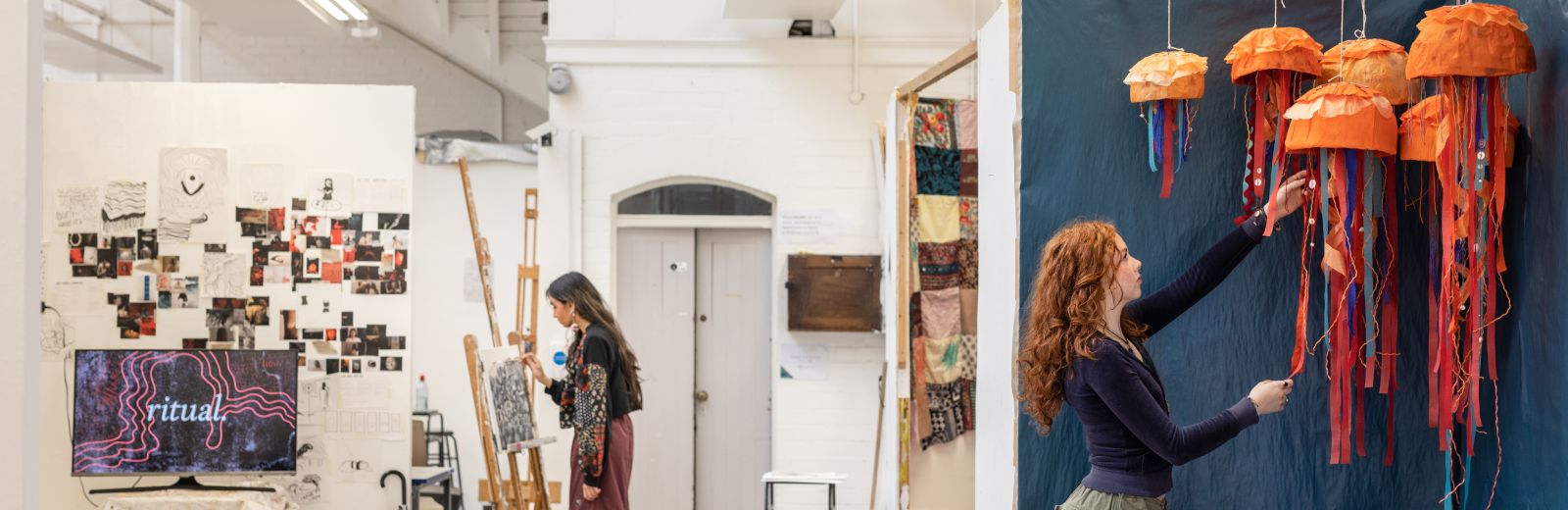
Unleash your inner creativity with the skills and confidence to fully realise your self-expression and solve problems with fresh thinking.
Studying art and design isn’t just about flexing your creativity. It’s about nurturing your critical thinking and problem-solving, so you can approach and tackle challenges with novel, unique perspectives.
Our BA Art and Design course empowers you to become a creative and critical thinker, able to explore practical uses for art and design. You’ll gain a wide set of skills that are adaptable throughout the ever-changing design landscape. You’ll learn about creative technologies, art and design theory, and how to tackle social and environmental issues with positive impact. Integral to fuelling your creative juices will be research and exploring themes, giving you a solid foundation of knowledge.
You’ll work across various formats and with others to develop solutions to problems, demonstrating your ability to think outside the box. Exploring unconventional ideas and bringing them to life will showcase your creativity, innovation and adaptability.
Learning through doing, you’ll develop imaginative and responsive approaches to artefact and image making that utilise the exciting fabrication and digital opportunities of the School of Design.
When I come into the creative space here in the School of Design, I feel at home. The friends you make from different parts of the world; your course mates who have grown with you, just tend to encourage you and keep you going.
Why study at Leeds?
- Hands-on practical experience: Work on exciting and authentic projects, with challenging briefs to meet.
- Supportive teaching: 92% of students surveyed say teaching staff have supported their learning well. (Discover Uni data)
- Learn in specialist facilities: Test your skills with our spaces and professional-grade tools, like our state-of-the-art equipment for polymer synthesis, fibre extrusion, yarn and fabric development, digital printing studio, and laboratory for materials testing and characterisation. Take a virtual tour of our facilities.
- Access to experts: Glean insights from visiting industry and academic experts, including School of Design alumni.
- Showcase your work: Our graduates have used the skills gained from their course to exhibit their work in leading art galleries throughout the country.
Course details and modules
The need for societal change is at the heart of our course, which develops your understanding of how you can use art and design to address issues of diversity, inclusivity and sustainability. You’ll learn and create with your fellow coursemates from the School, responding to contemporary challenges through cross-disciplinary design and creative thinking.
We highly value research activities and contextual studies as integral to contemporary creative practice. We believe that this means you’ll graduate with the flexibility, adaptability and resilience that employers are looking for.
Year 1
In your first year, you’ll learn how to research, analyse, think and write critically about art and design through hands-on study of historical and contemporary visual and material culture. We introduce skills in visual communication for a range of purposes. You’ll also be creatively challenged by varied design tasks and taught a range of design software skills to help you create art and design solutions and build your portfolio.
Year 2
In your second year, you’ll develop an awareness of professional standards within art and design as you expand your portfolio of practical work. You’ll use your academic knowledge to conduct and undertake critical analysis and evaluation, creating art and design-led responses to a variety of contemporary challenges.
You’ll also build skills in immersive and interactive design as you continue to expand your design knowledge and learn about more advanced ways of conducting research in industry.
Year 3
All of this will prepare you for your final year, in which you’ll apply all of the practical and academic skills you’ve gained. This will culminate in creative projects, where you’ll demonstrate your advanced art and design insights and communication skills. You are given room to expand your interests with two independent projects that will demonstrate your in-depth research and rigorous responses to a topic in the field.
Course structure
The list shown below represents typical modules/components studied and may change from time to time. Read more in our terms and conditions.
Year 1
Compulsory modules
Process, Making and Meaning (40 credits) - This module introduces you to the processes of research, design thinking, visualisation, experimentation, development and delivery of images, artefacts and objects integral to contemporary art and design practice. You’ll explore a selection of 2D, 3D, 4D, craft, industrial and digital making processes. The relevance of processes and making to contemporary art and design practice are discussed and you will reflect on the meaning of creative choices and strategies through visual and written research into current critical debates and challenges addressed by artists, designers and the creative industries.
Design Studies: Foundation (20 credits) - This module provides opportunities to develop the foundational skills of scholarly research, academic writing and critical thinking. You’ll be immersed in key issues and debates informing the changing values and future of design and consider how these have been influenced by social and historical forces. It will equip you with the skills to read and understand academic texts and apply theoretical ideas to your own design practice. You’ll also be introduced to research methods for finding and analysing texts and images.
You’ll develop your awareness of the complexity of challenges that design and society faces and an ability to analyse the relevance of and make connections between the contexts, issues and subject fields that will shape your future studies and professional careers.
Creative Challenges and Communication (20 credits) - This module involves a range of design challenges as you are taught a variety of design thinking, visual communication and software skills. Being able to visually communicate design solutions in a range of formats is fundamental to this module – principles of type choice, layout and image usage are taught.
You must take one module (each 20 credits) in a defined specialist area of study. These may include modules in areas such as:
- Visual Cultures and Vivid Futures
- Materiality in Design
You will also take another 20 credit optional module in the School of Design or 20 credits from the University's range of discovery modules.
Optional modules
(Each 20 credits)
- Creative Thinking
- Introduction to Photography
- Colour Design and Application
- Drawing beyond itself
- Editorial Design: Text, Image, Narrative
- Or a University of Leeds Discovery Module
Please note that the above are optional modules and will only run subject to sufficient enrolments. If a module has low student demand, it may not be offered, and you may be asked to choose an alternative
Year 2
Compulsory modules
Ideation, Materials and Technologies (40 credits) - This module introduces more advanced methods for the research, development and consolidation of ideas in order to arrive at a critical understanding of the relationship between materials, concepts and processes. You’ll be introduced to visual research methods appropriate for a more focused engagement with creative practice through an advanced understanding of ideas, material processes and critical appraisal.
Design Studies: Exploration (20 credits) - This module will develop your research and analysis skills and show you how these can be used to tackle the complex challenges faced by society today. You’ll learn how to apply a range of different research methods to explore the role design plays in our lives. This module will equip you with an understanding of how you can use visual and contextual research to create positive change in the world and the confidence to put this knowledge into practice.
Design for Interaction and Experience (20 credits) - This module teaches skills in planning and designing post digital experiences. Team-based demonstrations introduce you to the potential of emerging technologies that may shape the future of design. You will engage with current media theories that help contextualise your work. Practical principles of designing for physical interaction (such as designing installations or digital experiences) are introduced and you learn how best to present your creative ideas using a range of techniques.
You must take one module (each 20 credits) in a defined specialist area of study. These may include modules in areas such as:
- Books Arts
- Brand Strategy and Design
You will also take another 20 credit optional module in the School of Design or 20 credits from the University's range of discovery modules.
Optional modules
(Each 20 credits)
- Strategic Marketing for the Creative Industries
- Digital Photography
- Designing for Colour
- Contemporary Illustration
- Collage Culture
- The Art and Science of Cosmetic Products
- University of Leeds Discovery Module
Please note that the above are optional modules and will only run subject to sufficient enrolments. If a module has low student demand, it may not be offered, and you may be asked to choose an alternative
Year 3
Compulsory modules
Major Research Project (40 credits) - As the culmination of the degree programme, this module provides students with the opportunity to investigate a topic of relevance to their programme of study or design more broadly. By conducting original research as part of the final-year project, students will demonstrate coherent and detailed subject knowledge which is informed by the latest thinking in the discipline. While research will be conducted independently, students will be supervised by a member of academic staff.
Art and Design Self-Directed Project (60 credits) - The module provides students with the opportunity for the further exploration and consolidation of concerns that have developed in the Levels 1 and 2 modules. Students will employ appropriate media and processes to develop their ideas through to completed outcomes. Using various media, materials and technologies, the student’s creative and imaginative interests develop through the creation of original artworks/artefacts incorporating practice-led research methodologies. The final output of this module will include creative works and the presentation of practice-led research conducted in the development of this work. There will be an emphasis on the exhibition context, issues of curation, display and audience.
You will also take another 20 credit optional module in the School of Design or 20 credits from the University's range of discovery modules.
Optional modules
(Each 20 credits)
- Creative Advertising
- Collaborative Brand Management
- Fashion Styling and Photography
- Social Design
- Consumer Neuromarketing
- AI, Games Design, and Ethics
- Design in Scientific Enterprise
- University of Leeds Discovery Module
Please note that the above are optional modules and will only run subject to sufficient enrolments. If a module has low student demand, it may not be offered, and you may be asked to choose an alternative.
Learning and teaching
Creative problem solving and design thinking methods are central to our teaching in the School of Design. Your learning will be enhanced by a range of contemporary teaching methods which encourage active learning and are underpinned by inclusive and authentic learning activities, including team working, creative sprints and industry-facing scenarios.
We follow a campus-based blended learning approach, you’ll have a range of resources in the virtual learning environment which are always accessible, including videos and pre-work to help you prepare. You’ll attend lectures designed to invite engagement and participation, seminars which enable you to delve deeper into key topics, workshops to learn and practise design making, and critiques and tutorials to discuss work in progress.
Collaboration with staff and your peers is the foundation of our teaching and learning, giving you input into your learning journey. Some of your core modules will be studied with your coursemates from other design disciplines, so you will benefit from our community of learners, encountering diverse perspectives and exchanging your ideas with global industry practices in mind. Your module tutors have dedicated office hours, which means there is always the opportunity to ask questions.
A typical week in your first year may include eight to 12 hours of in-person and online study, one to three hours of specific workshop and studio activities, regular personal tutor sessions and private study. You’ll also have the ongoing support of your Academic Personal Tutor.
Private study is important at university and a potentially significant change from the way you have been taught previously. This is time where you can reflect and critique materials from taught session, including further reading, writing, designing and making. You’ll be guided through this process by your tutors to help you develop your knowledge and research skills. The ability to work independently is a key skill for your development as a creative professional and thinker.
There is an active visiting speakers course, formed of industry and academic experts, including School of Design alumni.
Specialist facilities
The School of Design offers excellent facilities and technical support for sharpening your creative skills. Have the freedom to work independently in our range of dedicated and inspiring spaces. You’ll also have access to practical workshop studios and specialist facilities, including our:
- sculpture programme studio
- 2D programme studio
- fashion design studio
- knit and weave studio
- photography studio
- digital print workshop
- laser cutting and 3D print workshop
- printmaking workshop
- XLab for Immersive Technologies
- 3D workshop
You can consult our expert technicians who are equipped with the skills that can help bring your work to life.
The School also provides valuable support to enhance your student experience and prepare you for the workplace:
- free dedicated software
- technical induction programmes
- free access to LinkedIn Learning
- free cameras and video recorder on loan
- supporting a Degree Show
- external promotion
- Yorkshire Fashion Archive and Membership to the Association of Suppliers to the British Clothing Industry
- visiting speakers from industry or other institutions around the world
Programme team
On this course, you’ll be taught by our expert academics, from lecturers through to professors. You may also be taught by industry professionals with years of experience, as well as trained postgraduate researchers, connecting you to some of the brightest minds on campus.
Assessment
The nature of assessment will change as you progress through your course:
at Level 1 assessments focus on your acquisition and understanding of new knowledge and practical, digital, academic and professional skills
at Level 2 assessments focus more on establishing how well you understand, analyse and apply this new knowledge and new skills in relation to real-world, local and global settings
in your final year study becomes more self-directed with forms of assessment often being negotiated and agreed with tutors
Throughout each year of study, it’s expected that you’ll find that assessments are progressively more challenging. To support you as you navigate assessment at the different levels of study, we provide formative as well as summative assessment. Formative assessment gives staff an opportunity to give you feedback on personal progress, in good time before a summative deadline. Given the range of assessment types in any one level of study, formative assessment and feedback enables you to reflect upon your personal progress and establish which forms of assessment allow you to play to your strengths.
Authentic assessment means relevant assessment, in terms of contemporary contexts and relevant to your personal interests and your future aspirations. The authenticity of assessment is an important consideration in how we design assignments and project briefs. This means that we think carefully about the relevance of assessment outcomes; not only in academic terms but also in terms of your chosen career path, skill development needs and the future of work in your chosen discipline. Where appropriate, there will be an element of choice in your assessment. Some projects will allow you to choose the focus and format of your submission.
Dialogic teaching methods emphasise in-class discussion and support student-staff debate. This approach to teaching and learning enables staff to hear all student voices. In turn, for some modules, this in-class dynamic may facilitate and inform the co-production of assessment tasks. Co-production of assessment tasks means that staff and students work together to devise fair and inclusive assessment; both formative and summative. This allows staff to consider the requirements of a module alongside opportunities to allow students to harness their strengths.
While remaining considerate of module and course learning outcomes, where relevant and beneficial, we strive to adopt a flexible approach to assessment design. This flexibility allows us to respond to student voice, maintain an agility that allows us to react to global, social and cultural change and respond swiftly to opportunities to devise projects with our industrial partners. We aim for all assessment to be relevant, meaningful and engaging.
Entry requirements
A-level: ABB including an Art/Design subject. Excluding General Studies and Critical Thinking.
If you have not studied art/design at A level, we may also consider your application based on a high grade at GCSE along with a portfolio of recent and relevant work. Please contact us for more information about portfolio submission.
GCSE: At least 5 at grade 4 (C) or above including English
Other course specific tests:
If predicted A in a relevant EPQ, alternative offer of A in EPQ plus BBB.
Alternative qualifications
Access to HE Diploma
Pass diploma with 60 credits overall, including at least 45 credits at level 3, of which 30 credits must be at Distinction and 15 credits at Merit or higher. An interview and a piece of written work may be required.
BTEC
DDM in art/design. Excluding Art Foundation Diploma; please see Other Qualifications section.
Example combination offers
Distinction in BTEC Extended Certificate/Subsidiary Diploma plus BB in two A Levels or Merit in BTEC Extended Certificate/Subsidiary Diploma plus AA in two A Levels
Distinction Distinction in BTEC Diploma plus C at A Level or Distinction Merit in the BTEC Diploma plus A at A Level
Cambridge Pre-U
M1, M1, M2 including art/design or media.
International Baccalaureate
34 points overall with 16 at Higher Level including 5 in Visual Arts and 4 in English.
Irish Leaving Certificate (Higher Level)
H2, H2, H2, H3, H3, H3 including art/design.
Scottish Highers / Advanced Highers
BB in Advanced Highers and AABBB in Highers OR B in Advanced Highers and AAABB in Highers OR AABBBB in Highers.
Welsh Baccalaureate
The Welsh Baccalaureate Advanced Skills Challenge Certificate (SCC) / Advanced Skills Baccalaureate Wales is acceptable in place of an A level. Applicants must achieve a grade B alongside AB at A level (excluding General Studies and Critical Thinking) .
Other Qualifications
UAL Extended Diploma: Distinction in the UAL Extended Diploma (or High Merit where available).
Art Foundation course: Whilst we welcome art foundation students, this is not a formal requirement for entry and doesn’t usually count towards entry requirements.
In exceptional cases, we may make you an offer conditional on achieving an Art Foundation qualification; we may consider your application if you’re taking a validated Art Foundation course and have ABB or above at A-level not including Art or Design.
If you’re taking the EPQ, we may make you an alternative offer in addition to the standard offer. In this case that would be BBB, plus EPQ grade A.
Read more about UK and Republic of Ireland accepted qualifications or contact the School’s Undergraduate Admissions Team.
Alternative entry
We’re committed to identifying the best possible applicants, regardless of personal circumstances or background.
Access to Leeds is a contextual admissions scheme which accepts applications from individuals who might be from low income households, in the first generation of their immediate family to apply to higher education, or have had their studies disrupted.
If you live in a neighbourhood where there is low participation in higher education, we may be able to give priority to your application.
Find out more about Access to Leeds and contextual admissions.
Arts and Humanities with Foundation Year
This course is designed for students whose backgrounds mean they are less likely to attend university (also known as widening participation backgrounds) and who do not currently meet admissions criteria for direct entry to a degree.
The course will give you the opportunity to be taught by academic staff and provides intensive support to enable your development of academic skills and knowledge. On successful completion of your foundation year, you will progress to your chosen degree course. Find out more about the Arts and Humanities with Foundation Year
Alternative Entry Scheme for Mature Students
If you are a mature applicant (over 21) and you don’t have the required A Levels or GCSE English and maths qualifications, you can complete our Alternative Entry Scheme (subject to meeting the eligibility criteria for the scheme). As part of this, you may be asked to take tests in English and maths and to write an essay.
Contact the Lifelong Learning Centre for more information.
International
We also accept a range of international qualifications. Please visit our international equivalencies page for more details on recognised qualifications from your region.
International foundation year
International students who do not meet the academic requirements for undergraduate study may be able to study the University of Leeds International Foundation Year. This gives you the opportunity to study on campus, be taught by University of Leeds academics and progress onto a wide range of Leeds undergraduate courses. Find out more about International Foundation Year programmes.
English language requirements
IELTS 6.0 overall, with no less than 5.5 in any component. For other English qualifications, read English language equivalent qualifications.
Improve your English
If you're an international student and you don't meet the English language requirements for this programme, you may be able to study our undergraduate pre-sessional English course, to help improve your English language level.
Fees
UK: £10,050
International: £29,600 (per year)
The amount of tuition fees you pay is based on whether you are classified as a home (UK) or international student. Find out how we assess your fee status.
Tuition fees for UK students
Tuition fees for UK undergraduate students starting in 2027/28 are £10,050.
Subsequent years
The UK government sets the maximum tuition fee caps that universities can charge UK students. This means your tuition fee in future academic years will reflect any changes set by the government.
From 2028/29 onwards, tuition fees are likely to increase annually, at least in line with inflation, and may rise further if the government increases the fee cap.
Tuition fees for international students
The international fee applies for each year of full-time study and will remain the same for the duration of your course.
Read more about tuition fees.
Tuition fees for a study abroad or work placement year
If you take a study abroad or work placement year, you’ll pay a reduced tuition fee during this period. For more information, see Study abroad and work placement years on our tuition fees page.
Additional cost information
There are additional costs of study that students need to cover. We estimate that these additional costs could be as described below, but this amount may vary depending on how you decide to respond to university briefs and the range of materials and techniques you decide to adopt.
Equipment and material costs
Students need to cover the cost of printing their work during the course, including specialist print workshop costs. Students also need to cover costs of copying and supplying their own basic materials (eg pens, pencils, cutting tools, paper, ruler) and more course specific materials (eg sketchbooks, specialist papers, specialist fabrics, sculpting materials, specialist tools) as well as print portfolios.
The approximate cost of these items in recent years has been:
• Level 1 – £100 - £170
• Level 2 – £100 - £150
• Level 3 – £200 - £600
Computers and digital equipment
To ensure you can make the most of your studies at Leeds, you’ll need to make sure your laptop meets the system requirements for your course.
This courses require the development of work using industry standard specialist software. As/if required by your course, the School will provide this to you when you arrive. We also use a blended learning model where you’ll need to access course materials and video conference using a computer or mobile device (eg laptop, tablet, smartphone). Costs for a laptop will vary depending on the exact specification. You should expect to pay between £1,500–£2,500.
If you’re buying a new laptop for your studies, then we recommend that you wait until you’re registered as a student so that you take advantage of discounts given to university students. Delaying purchasing also allows you to find out from your course leader what you need. Depending on your circumstances you may be able to benefit from a Student Loan or Bursary, or the University Financial Assistance Fund.
You’ll also have access to further digital equipment in our studios and by using our loan scheme. You may decide to purchase your own equipment (from Year 1 or as your studies progress) which will result in additional optional costs. Examples include a drawing tablet (£150–£500) or a digital camera (£200–£1500).
Scholarships and financial support
If you have the talent and drive, we want you to be able to study with us, whatever your financial circumstances. There is help for students in the form of loans and non-repayable grants from the University and from the government. Find out more in our Undergraduate funding overview.
There may be additional costs related to your course or programme of study, or related to being a student at the University of Leeds. Read more on our living costs and budgeting page.
Scholarships and financial support
If you have the talent and drive, we want you to be able to study with us, whatever your financial circumstances. There is help for students in the form of loans and non-repayable grants from the University and from the government. Learn more about undergraduate funding.
Scholarships are also available to help fund your degree. Find out more and check your eligibility below:
Applying
Apply to this course through UCAS. Check the deadline for applications on the UCAS website.
Read our guidance about applying.
International students apply through UCAS in the same way as UK students. Our network of international representatives can help you with your application. If you’re unsure about the application process, contact the admissions team for help.
Read about visas, immigration and other information in International students. We recommend that international students apply as early as possible to ensure that they have time to apply for their visa.
Documents and information you’ll need
If you have not studied art/design at A-level (or equivalent), we may also consider your application based on a high grade at GCSE along with a portfolio of relevant work. Please contact us for more information on portfolio submission.
Computers and digital equipment
To ensure you can make the most of your studies at Leeds, you’ll need to make sure your laptop meets the system requirements for your course.
This courses require the development of work using industry standard specialist software. As/if required by your course, the School will provide this to you when you arrive. We also use a blended learning model where you’ll need to access course materials and video conference using a computer or mobile device (eg laptop, tablet, smartphone). Costs for a laptop will vary depending on the exact specification. You should expect to pay between £1,500–£2,500.
If you’re buying a new laptop for your studies, then we recommend that you wait until you’re registered as a student so that you take advantage of discounts given to university students. Delaying purchasing also allows you to find out from your course leader what you need. Depending on your circumstances you may be able to benefit from a Student Loan or Bursary, or the University Financial Assistance Fund.
You’ll also have access to further digital equipment in our studios and by using our loan scheme. You may decide to purchase your own equipment (from Year 1 or as your studies progress) which will result in additional optional costs. Examples include a drawing tablet (£150–£500) or a digital camera (£200–£1500).
Admissions policy
University of Leeds Admissions Policy 2027
This course is taught by
Contact us
School of Design Undergraduate Admissions
Email: designundergrad@leeds.ac.uk
Career opportunities
Flexibility, resilience and transferable skills are hugely desirable skills for creative industry professionals.
In the School of Design, you’ll take on expert knowledge from tutors with strong links to research and industry. You’ll also hone your skills, such as sustainable business development, research, creative problem-solving, and communication, for a variety of careers. Design thinking, combined with excellent research and critical skills, are increasingly valued across a wide range of sectors. Therefore, your University of Leeds degree opens up a rich potential of opportunities across disciplines and multiple industries.
As well as specialist art and design practice skills, you’ll develop sound professional awareness and be able to research different topics independently.
Our graduates have pursued a wide range of careers – many continue with their own practice as artists or designers. A selection of exhibitions by recent graduates includes:
- London Original Print Fair – Royal Academy of Art
- Baltic Gallery
- Jerwood Drawing Prize
- Saatchi’s New Sensations
- Arts at Trinity Leeds
- Art in Unusual Places, Leeds
Where this degree could take you
Our graduates have chosen careers related to art and design in a variety of roles, including:
- art gallery manager
- fabricator
- illustrator
- editorial assistant
- graphic designer
- journalist
- theatre staging design
- lecturer
- learning support worker
- artist in residence
- study centre assistant
University of Leeds Art graduates have worked for a wide range of companies and institutions, including:
- Victoria and Albert Museum
- Penguin Random House
- National Portrait Gallery
- Arts Council Collection
- Pinewood Studios
- Cath Kidston
- Channel 4
Some have also decided to move on to postgraduate studies in disciplines such as fine art, design, material futures, art and science, environmentalism, advertising, landscape architecture, illustration, set design, scenic arts, museum studies and curating. Others have stepped into careers in accounting, law, marketing, journalism, education, medicine and retail.
Top 10 most targeted for 10+ years
by the UK's leading employers
Careers support
At Leeds, we help you to prepare for your future from day one.
Our Careers Service has the global expertise and sector-spanning industry partnerships that, combined, go way beyond simply helping you get a job. They provide you with the resources you need to upskill and achieve the future you aspire towards – even in the face of lightning-paced change.
- Dedicated Employability Team: Meet with our qualified careers consultants and specialist employability and placements officers, on hand to help you choose the right path and develop the skills to get there. They can support with CV and cover letter writing, LinkedIn profile building, mock interviews and navigating AI: get confident with tailored advice and techniques.
- Employability and networking events: Get involved in a full range of events, including careers fairs and specialist industry talks with employers who are actively recruiting. You’ll also benefit from mentoring and a supportive careers community, helping you make connections, build your network, and shape your journey as a future professional.
- Skills training: We embed transferable skills training in all our programmes to support your transition to the workplace. Gain expertise employers value, such as communication, problem-solving and research and data analysis.
- MyCareer system: Access a dedicated portal where you can book careers appointments, view helpful resources and browse vacancies and events. Access digital tools, including LinkedIn support, video‑interview preparation, plus global job market and visa guidance. We also offer pre‑arrival support to help you prepare for career planning in the UK and make the most of your time with us.
- Exclusive opportunities: Bring your enterprise to market with our award-winning business advice service, Spark. Apply for vacancies only available to our students. And hone your skills further with Leeds University Union, home to volunteering opportunities and over 300 clubs and societies.
Study abroad and work placements
Study abroad
On this course, you can apply to study abroad, usually as an extra academic year. We have over 300 University partners worldwide and popular destinations for our students include Europe, the USA, Canada, Australia, New Zealand, Singapore, Hong Kong, South Africa and Latin America.
Work placements
Make connections, practice skills and build future confidence in your future with an industrial placement year as part of your course.
A work placement can be a great investment in your future:
- Choose from 100+ organisations in the UK and overseas.
- Build industry contacts within your chosen field.
- Be in direct contact with potential employers thanks to our close industry links.
- Advance your experience and skills by putting course teachings into practice.
- Gain invaluable insight into working as a professional in your chosen industry.
- Improve your employability.
- All placements sourced by the University are paid positions
- We also offer shorter-term placement opportunities.
Our Employability Team are here to help you every step of the way. They run several placement sessions to answer your questions, discuss available opportunities and support you with CV writing and interview preparation.
If you decide to undertake a placement year, your period of study will be extended by 12 months.
If your application is successful, during placement, you'll be supported by an industrial supervisor from within the company, plus an academic supervisor who will keep in touch throughout.
On successful completion of your placement year, you'll be awarded the ‘industrial’ variant in your degree title to demonstrate your added experience to future employers.
Students in our Faculty have recently completed placements at:
- Saatchi Gallery
- Artichoke Print Workshop
- Outsight Studio
- Pontone Gallery
We can’t guarantee a work placement. The job market is competitive – and there may be competition for the placement you want. You’ll have to apply the same way you would for any job post, with your CV and, if successful, attend an interview with the organisation. That said, we encourage everyone to apply.