Course overview
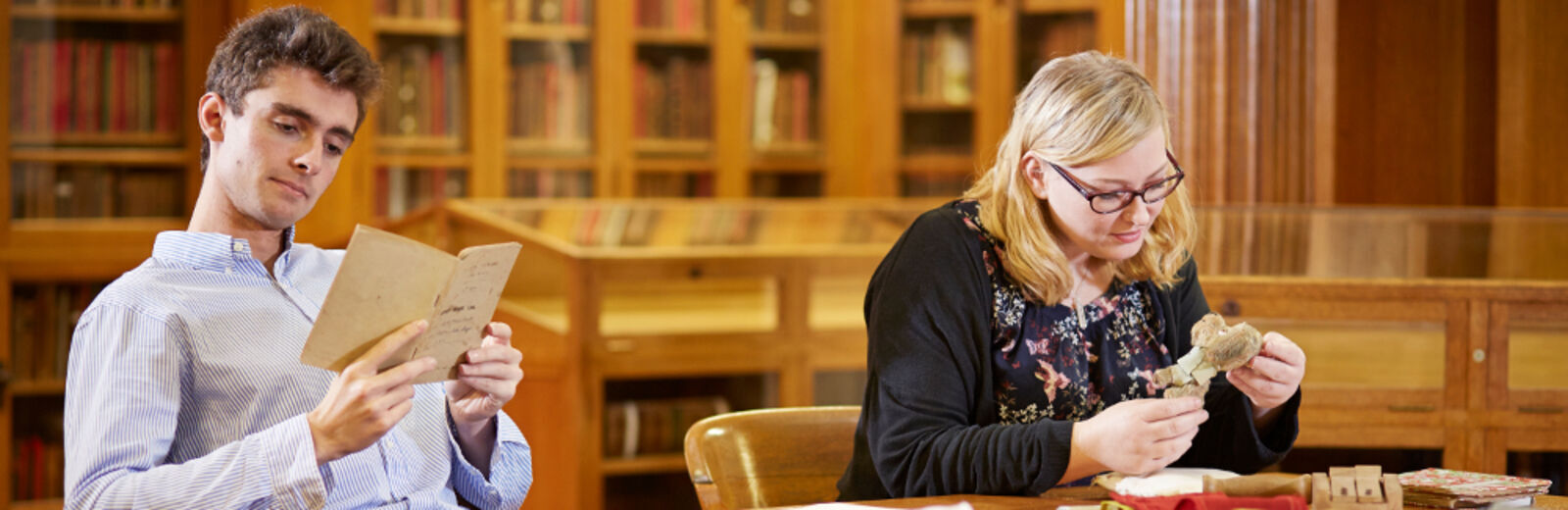
Develop your critical thinking as you connect with the past and understand how it shapes our future.
History connects us to people, institutions, places, objects and ideas, and it shapes everything from world politics to technological innovations. Understanding it helps us define who we are and how we can better ourselves for tomorrow.
On this MA History course, you’ll explore history and its relation to the world using a range of perspectives. You’ll learn in one of the largest History departments in the country, engaging with tutors working at the cutting edge of historical research, whose work shapes national and international debate.
You’ll have the chance to define how you study your course, from explorations into state archives to considering popular culture and everyday life. You’re also supported to follow more than one approach, as you collaborate with other historians who ask alternative questions, draw from different sources and see the past differently.
You’ll learn in the heart of Leeds, a city steeped in historical significance. With excellent local resources at your disposal, you’ll also benefit from robust links to our community and region, encompassing major national heritage institutions and world heritage sites.
Upon graduation, you’ll have skills in critical thinking, communication and practical research to flourish in your chosen career.
It's great to be part of the School of History community, where everyone has an obvious love of the subject. I have been made to feel very welcome as a mature student by all the others on the course.
Why study at Leeds?
- Far-reaching academic expertise: Learn in one of the UK’s leading history departments, with tutors specialising in a wide range of perspectives, including public history, gender history, histories of health and disability, and cultural history.
- An engaging research community: Join our vibrant research community, which hosts talks, seminars, workshops and conferences throughout the year, supported by several specialist research groups.
- A rich historical archive on your doorstep: Access the Brotherton Library, one of the UK’s leading research libraries, with a wealth of manuscript and printed materials dating from the medieval to the modern period. You’ll also be encouraged to make the most of onsite archives and digital resources.
- Benefit from local partnerships: Visit our partner institutions, such as Leeds City Museums and Galleries, the Thackray Museum of Medicine, West Yorkshire Archive Service, and the Royal Armouries, among others.
- Gain real work experience: You’ll have the opportunity to undertake a 50-hour work placement with one of our partner institutions, which have previously included University of Leeds Cultural Collections, Leeds City Museums and Galleries, and the West Yorkshire Archive Service.
- Real-world industry experience: Network with clients and gain consultancy experience as part of our 2-week online Global Industry Programme.
Explore Leeds
Discover our campus, facilities and accommodation with our 360 virtual experience platform.
With immersive 360 experiences, image galleries, virtual tours, videos and day-in-the-life content, you can take a personalised, interactive tour of campus and explore the University's academic, social and residential environments from anywhere in the world.
You can get a feel for what it's really like to live, learn and belong at the University of Leeds – all from the comfort of home.
Course details and modules
The course has two core modules (worth 30 credits each). You’ll take a further two optional modules (worth 30 credits each) and complete a 60-credit dissertation.
You can take this course on a full-time (12 months) or a part-time (24 months) basis. As a full-time student, you will take two 30-credit core modules in semester 1 and two optional modules in semester 2. You’ll submit your dissertation in the 12th month of study. As a part-time student, you will take one 30-credit module each semester of both Year 1 and Year 2, with the dissertation submitted in the 24th month of study.
The core modules encourage you to develop and refine the skills you need to study history and communicate your work. You'll build confidence working with different historical approaches and incorporating these different approaches into your own historical practice as you learn the skills you need to share your own research and understand how historians have developed their research and ideas.
The optional modules allow you to specialise and have been developed to reflect the research strengths of the School. Whether you wish to focus on an existing interest or do something entirely new, our range of staff expertise enables you to study topics in depth. The dissertation enables you to put the knowledge and skills you have gained into practice in an extended piece of historical writing.
Course structure
The list shown below represents typical modules/components studied and may change from time to time. Read more in our terms and conditions.
Year 1 Compulsory modules
Dissertation MA (60 credits)
You will produce either a traditional written dissertation or a public history project. Whichever format you decide to follow, your project will be based on original research, and you will work with an academic supervisor.
Communicating History (30 credits)
Understand how history is communicated, consumed, and contested in the contemporary world.
Researching History (30 credits)
This module asks students to consider the discipline of history and then link this to their own historical practice. There will be an element of curriculum co-creation each year to reflect each student cohort’s interests and priorities.
Year 1 optional modules (selection of typical options shown below)
- History of Migrations (30 credits)
- Making History: Archive Collaborations (30 credits)
- Global Health Histories (30 credits)
- Early Modern Cities (30 credits)
Learning and teaching
This course will connect you with the latest research and thinking in the broad field of history.
Our staff are dedicated teachers as well as experts in their field, and their teaching is informed by their own cutting-edge research. Most of your optional modules will be taught through weekly two-hour seminars, where you’ll discuss major concepts, debates, and sources with a small group of students and your tutor. You might also be taught through workshops, where you are expected to take a practical role, and occasionally via talks and lectures.
Independent study also forms an important part of this degree, giving you the space to develop into a researcher in your own right. You will be supervised by one member of staff for your dissertation and can arrange to consult with other members of staff around their areas of expertise. The school has a rich culture of research seminars, which bring together our staff and students, as well as historians from other universities giving papers which you can attend.
On this course, you’ll be taught by our expert academics, from lecturers through to professors. You may also be taught by industry professionals with years of experience, as well as trained postgraduate researchers, connecting you to some of the brightest minds on campus.
Assessment
You will be assessed through a variety of approaches, including essays, dissertations, book and literature reviews, and podcasts. Fairness and inclusivity will be ensured through opportunities for formative assessment and in the provision of training where skills and support are required. You might also be offered a choice of assessment, for example, between an essay and a podcast or between a presentation and a literature review.
The assignments you will complete have been designed to help you develop critical skills that are valued by employers. In the course, you will need to be able to research independently to evaluate claims and arguments to come to a reasoned conclusion. You will also need to produce convincing evidence to support your conclusions. Certain tasks, like presenting to an in-person audience, designing and producing a podcast or working with others to produce a joint output, will similarly help you to boost your employability skills.
You will be given an assessment brief for every summative assessment to ensure expectations are transparent and inclusive. Your tutors will use the rubric provided on the brief to assess your work. Our marking and assessments are reviewed by a rigorous quality assurance process, including check marking by a second colleague and review by external examiners.
Specialist facilities
You’ll have extensive use of world-class facilities at Leeds as part of your teaching. This includes but is not limited to the Bedford Research Centre in Cultural Collections and HELIX, the University’s learning innovation hub, a place where staff, students and the wider community can engage in immersive technologies, work in cutting-edge podcasting studios and also make use of a physical makerspace.
Applying
Entry requirements
You’ll need a Bachelor degree with a 2.1 (hons) or equivalent qualification, preferably in History or a related humanities or social science degree specialising in one of the subjects listed under ‘related subjects'.
We will also consider applicants with relevant experience, an interest in History, humanities or social sciences or coming from an area of expertise to which History, humanities or social sciences is complementary such as the ones listed under ‘Other areas’.
We welcome applicants from a diverse range of subject disciplines, so please do not hesitate to apply if your subject is not listed.
We welcome applicants from varied professional and personal backgrounds, including people returning to academic study after time away.
You will need to respond to the questions in the supporting statement section of your online application form to explain why you wish to study this particular course and your career plans. Relevant professional experience may also be considered. We may request additional documentation to inform our decision.
Modern history related subjects
- politics
- sociology
- english
- modern languages
- philosophy
- religious studies
- heritage studies
- classical studies
- liberal arts
Other areas
- archaeology
- linguistics
- business studies
- economics
- law
- anthropology
- musicology
- media Studies
- journalism
- information management
- public administration
- geography
- international relations
- development studies
- education
Our admissions team are experienced in considering a wide range of international qualifications. If you wish to discuss whether your qualifications will meet the necessary entry criteria, contact the School’s admissions team.
You can also check the accepted qualifications for your country or region.
English language requirements
IELTS 6.5 overall, with no less than 6.0 in any component. For other English qualifications, read English language equivalent qualifications.
Improve your English
International students who do not meet the English language requirements for this programme may be able to study our postgraduate pre-sessional English course, to help improve your English language level.
This pre-sessional course is designed with a progression route to your degree programme and you’ll learn academic English in the context of your subject area. To find out more, read Language for Arts and Humanities (6 weeks) and Language for Social Science and Arts: Arts and Humanities (10 weeks).
We also offer online pre-sessionals alongside our on-campus pre-sessionals. Find out more about our six week online pre-sessional, our 10 week online pre-sessional or our 16 week online pre-sessional.
You can also study pre-sessionals for longer periods – read about our postgraduate pre-sessional English courses.
How to apply
The ‘Apply’ link at the top of this page will take you to information on applying for taught programmes and to the University's online application system.
If you're unsure about the application process, contact the admissions team for help.
Please see our How to Apply page for information about application deadlines
The ‘Apply’ link at the top of this page will take you to information on applying for taught programmes and to the University's online application system.
If you intend to apply for funding, we advise you to submit an application for your chosen course as early as possible and at least one month before any scholarship deadline.
If you're unsure about the application process, contact the admissions team for help.
Documents and information you'll need
- A copy of your degree certificate and transcripts, or a partial transcript if you’re still studying (please submit an official English translation where the original is not in English)
- Your approved English Language test* (if applicable)
- A personal statement in response to the questions asked in the supporting statement section of the application form
- A full up-to-date CV
- Any previous UK CAS, visa and BRP documents if you’re an international applicant who has previously studied in the UK on a Tier 4/ Student Visa.
* Applicants who have not yet completed an approved English language test may apply for a Masters course prior to taking a test.
Personal Statement Requirements
Please summarise your reasons for applying to this particular programme of study. Your response can include details of your previous study/work experience relevant to the programme and career ambitions. Your response can provide us with important information on your suitability for the course, so please complete carefully.
Please explain why you have chosen to apply for this Masters course at the University of Leeds by answering the following questions in separate numbered paragraphs:
- What areas of this course particularly interest you and why? Have you studied these before? Please explain your reasons for applying to this particular Masters course
- Why do you want to study this course at Leeds? Please comment on aspects such as available resources at the University and in the city, research specialisms within the school or academics you would like to work with.
- What potential themes have you considered for dissertation research?
- How will studying for this course help you to achieve your longer term goals?
- Why do you see this course as a particularly valuable subject to study?
- What skills and experience do you have that have prepared you for this course? You may like to give details of any final year work/projects you have previously undertaken, relevant work experience etc.
Relevant work experience might include: Research, Journalism, Creative Industries, Cultural Industries, Galleries, Museums, Archiving, Education, Historian. Publishing, Libraries, Cultural Policy, Politics.
Next Steps
Where further information to support the assessment of your application is needed, we may ask for a recent sample of written work.
We do not generally request references, unless further information is required to support the assessment of your application.
Please summarise your reasons for applying to this particular programme of study. Your response can include details of your previous study/work experience relevant to the programme and career ambitions. Your response can provide us with important information on your suitability for the course, so please complete carefully.
Please explain why you have chosen to apply for this Masters course at the University of Leeds by answering the following questions in separate numbered paragraphs:
- What areas of this course particularly interest you and why? Have you studied these before? Please explain your reasons for applying to this particular Masters course.
- Why do you want to study this course at Leeds? Please comment on aspects such as available resources at the University and in the city, research specialisms within the school or academics you would like to work with.
- What potential themes have you considered for dissertation research?
- How will studying for this course help you to achieve your longer term goals?
- Why do you see this course as a particularly valuable subject to study?
- What skills and experience do you have that have prepared you for this course? You may like to give details of any final year work/projects you have previously undertaken, relevant work experience etc.
Relevant work experience might include: publishing, museum and galleries work, volunteering, teaching and education.
Read about visas, immigration and other information in International students. We recommend that international students apply as early as possible to ensure that they have time to apply for their visa.
Admissions policy
University of Leeds Admissions Policy 2027
This course is taught by
Contact us
Student Education Service Office
Fees
UK: £12,400 (Total)
International: £27,300 (Total)
For fees information for international taught postgraduate students, read Masters fees.
Part-time fees
Fees for part-time courses are normally calculated based on the number of credits you study in a year compared to the equivalent full-time course. For example, if you study half the course credits in a year, you will pay half the full-time course fees for that year.
Additional cost information
There may be additional costs related to your course or programme of study, or related to being a student at the University of Leeds. Read more on our living costs and budgeting page.
Scholarships and financial support
If you have the talent and drive, we want you to be able to study with us, whatever your financial circumstances. There may be help for students in the form of loans and non-repayable grants from the University and from the government. Learn more about Masters funding.
Scholarships are also available to help fund your Masters. Find out more and check your eligibility below:
Career opportunities
As an MA History graduate, you can progress into a wide range of careers across the public, private and third sectors. The analytical, research and communication skills you develop on the course are highly valued by employers, enabling you to move into roles where critical thinking, evidence‑based decision‑making and clear communication are essential.
Previous history graduates have gone on to careers in journalism, policy making, research, heritage, museums and archives, as well as roles in the private sector where strong analytical and organisational skills are required. Many also pursue careers in education, community engagement, cultural programming, project and events management, marketing, public relations and consultancy. The ability to interpret complex information, construct persuasive arguments and communicate ideas clearly prepares you for roles in think tanks, NGOs, charities, government bodies and cultural organisations.
The course also equips you with transferable skills that open pathways into sectors such as communications, digital content creation, publishing, information management, and roles that involve public‑facing storytelling or historical interpretation. Increasingly, graduates use their skills in emerging areas such as digital humanities, podcasting, media production and public history initiatives.
A number of students continue their studies at PhD level, either at Leeds or other leading institutions, progressing into academic careers or research‑focused roles within universities, heritage organisations and cultural institutions.
Whatever direction you choose, the MA History provides a strong foundation for careers that require intellectual curiosity, rigorous analysis and the ability to communicate ideas with clarity and impact.
Where this degree could take you
Here’s an insight into the job roles some of our History MA graduates have obtained:
- Accounts Coordinator, Mednet
- Caseworker, HMRC
- Business analyst, Citizens Advice
- Customer Account Manager, Civil Service
- Freelance Writer and Editorial Consultant
Top 10 most targeted for 10+ years
by the UK's leading employers
Careers support
We offer a wide range of support to help you work towards your career goals. Our modules are designed to develop the high‑level research, analytical and communication skills that employers look for, and you’ll have opportunities throughout the course to build confidence in applying these skills in professional contexts.
You’ll receive regular updates through our MA newsletter, which highlights events, workshops and opportunities available to postgraduate students across the School, Faculty and University.
Alongside talks and activities organised within the School, you’ll have full access to the University’s comprehensive Careers Service. They provide both online and in-person support on campus, including one-to-one guidance, CV and application advice, interview preparation, and specialist resources tailored to postgraduate students. This support continues after you graduate, helping you plan your next steps with confidence.
Together, these opportunities ensure you are well‑supported throughout your degree, with clear pathways to develop your skills, explore career options and prepare effectively for employment or further study.
- Dedicated Employability Team: Meet with our qualified careers consultants and specialist employability and placements officers, on hand to help you choose the right path and develop the skills to get there. They can support with CV and cover letter writing, LinkedIn profile building, mock interviews and navigating AI: get confident with tailored advice and techniques.
- Employability and networking events: Get involved in a full range of events, including careers fairs and specialist industry talks with employers who are actively recruiting. You’ll also benefit from mentoring and a supportive careers community, helping you make connections, build your network, and shape your journey as a future professional.
- Skills training: We embed transferable skills training in all our programmes to support your transition to the workplace. Gain expertise employers value, such as communication, problem-solving and research and data analysis.
- MyCareer system: Access a dedicated portal where you can book careers appointments, view helpful resources and browse vacancies and events. Access digital tools, including LinkedIn support, video‑interview preparation, plus global job market and visa guidance. We also offer pre‑arrival support to help you prepare for career planning in the UK and make the most of your time with us.
- Exclusive opportunities: Bring your enterprise to market with our award-winning business advice service, Spark. Apply for vacancies only available to our students. And hone your skills further with Leeds University Union, home to volunteering opportunities and over 300 clubs and societies.
Work placements and industry experience
If you enrol on the module Archive Collaborations, you’ll undertake a 50-hour work placement in conjunction with one of our partner institutions. In previous years, these have included University of Leeds Cultural Collections, Leeds City Museums and Galleries, and the West Yorkshire Archive Service.
Global Industry Programme
As a Masters student at Leeds, you’ll have the unique opportunity to gain real-world industry experience with our Global Industry Programme.
You’ll develop key professional skills and gain invaluable insight into working in your chosen field, helping to solve a real business problem from a live company brief.
This experience will enhance your CV, helping you stand out in the competitive graduate jobs market and improving your chances of securing the career you want.
Benefits of the Global Industry Programme:
- Fully online and designed to fit around your studies.
- Opportunities to make professional networks in areas such as digital marketing, business growth, sustainability and funding strategy.
- Gain valuable insight and build consultancy experience with a UK or international organisation, working on a time limited brief.
- Work as part of a team across disciplines to tackle real business needs.
- Advance your experience and hands-on skills by putting the course teachings into practice.
- Improve your employability prospects.
- Make new friends, build confidence and consider your future plans.