Biopharmaceutical Development (Industrial Placement) MSc
Year of entry 2026
- Start date
- Delivery type
- On campus
- Duration
- 48 Months (Part time)
- Entry requirements
- A bachelor degree with a 2:1 (hons)
Full entry requirements - English language requirements
- IELTS 6.5 overall, with no less than 6.0 in all components
- UK fees
- £22,000 (Total)
- International fees
- £37,500 (Total)
- Contact
- fbspgt@leeds.ac.uk
Course overview
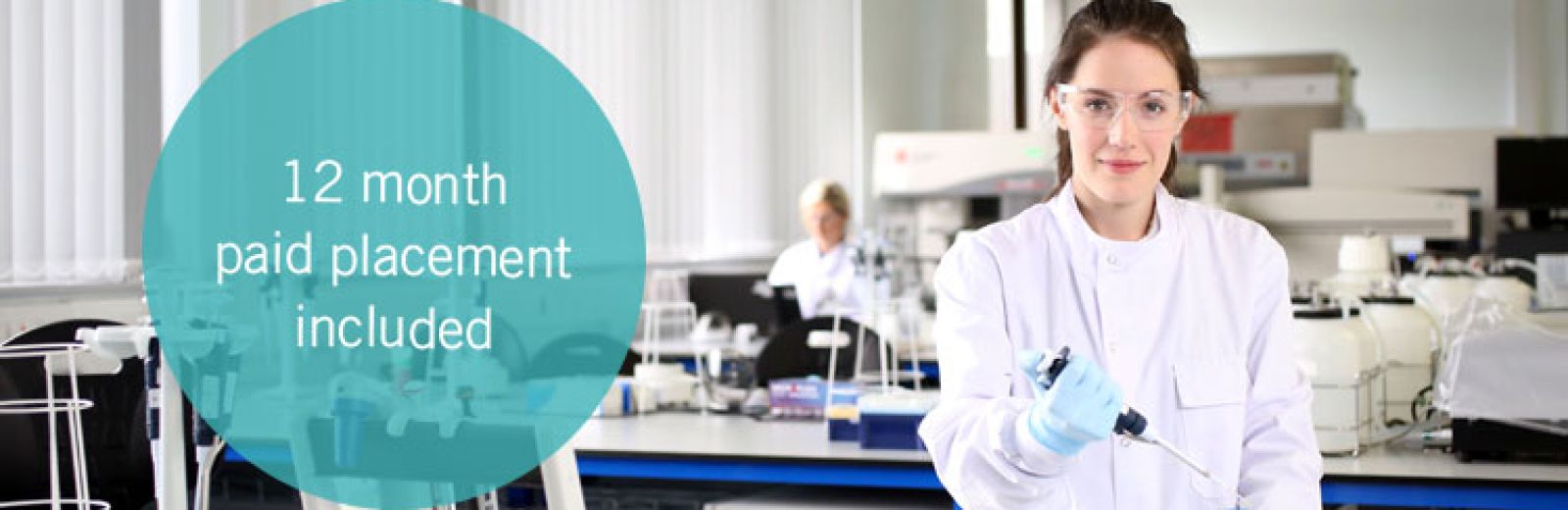
Develop the medicines of the future and fast-track your career into the scientific industry.
Biopharmaceutical drugs are transforming the way we treat patients and fight global disease. The future of drug treatment includes biologically manufactured drugs, namely hormones, monoclonal antibodies, gene therapies and cell therapies.
Designed, developed and delivered in partnership with Labcorp Drug Development (formerly known as Covance), this course will provide you with a springboard into a career in the biopharmaceutical industry or further research in an academic environment. On this programme, you’ll be immersed in hands-on training and gain specialised, industry-relevant experience, ready to fast-track talented scientists into the industry. Underpin all your learning with theoretical knowledge as you develop a detailed understanding of the full biological drug development pathway.
Many pharmaceutical companies are expanding their biopharmaceutical capability, creating a demand for talented, well-trained professionals with the right skill set. Graduates have gone on to secure roles as an analytical scientist, project manager, or coordinator, in areas such as research, quality control, manufacturing, non-clinical, clinical, and market access. You’ll also be in a strong position to undertake further research at Leeds or elsewhere.
Industrial placement year
This programme gives you the opportunity to undertake a paid industrial placement year as part of the course. Our close industry links give you the platform to apply to a number of major organisations such as Procter and Gamble, Eli Lilly and Johnson & Johnson.
‘Any student passionate about pharmaceuticals and who aspires to work within the industry should definitely consider this course.’
Robyn Hoare, MSc Biopharmaceutical Development (Industrial Placement)
Why study at Leeds:
- Accredited by the Academy of Pharmaceutical Sciences: The programme has earned national recognition, receiving the Princess Royal Training Award in 2020 and 2023, as well as the Advance HE Collaborative Award for Teaching Excellence (CATE) in 2025.
- Accelerate your career: Designed to fast-track talented scientists into industry.
- Gain real-world experience: Enhance your career prospects and give your CV that competitive edge before you graduate by applying for a paid industrial work placement year.
- Develop specialised knowledge: An integrated understanding of the full biological drug development pathway.
- Focus on drug discovery and development: Learn about large molecule drugs such as monoclonal antibodies, bio-similars, antibody-drug conjugates and gene therapies.
- Strengthen your teamworking skills: Gain extensive experience of team-based project planning.
Accreditation
Accredited by the Academy of Pharmaceutical Sciences, the programme has also earned national recognition, receiving the Princess Royal Training Award in 2020 and 2023, as well as the Advance HE Collaborative Award for Teaching Excellence (CATE) in 2025.
Course details and modules
The course content focuses on the discovery and development of large molecule drugs: monoclonal antibodies , antibody-drug conjugates and gene therapies. Added to this is practical hands-on training in the technologies that underpin the discovery and development pathway. You’ll receive training in protein purification, characterisation, formulation and assessment of binding function and the use of cell-based assays to look at drug potency.
Semester 1
The course is 20-months long, with the first eight months on campus at the University of Leeds covering all aspects of biological drug discovery, development and commercialisation. This will give you an understanding of the many functions that contribute to a successful drug and how they are coordinated and integrated to bring new drugs to market in a timely and economic fashion.
The course is co-taught by academics and qualified industry professionals, both working at the forefront of their fields in the areas of science that support drug development. You’ll, therefore, be exposed to learning that emphasises how knowledge is being applied in an industrial context. You’ll have the opportunity to develop a strong skill set valued by industry and academia, including problem-solving, strong communication and teamwork skills delivered through novel learning and teaching modes such as team assignments delivering reports to clients, regulators and investors and the ability to conduct experimental research.
Semester 2
The second half of your programme is an industrial placement assignment. This is a 12-month guaranteed work and research experience in industry.
The placements will all primarily include practical research project where you will gain in-depth practical experience of at least one technical function of the drug development process (discovery, manufacturing, pre-clinical testing, clinical safety and efficacy). However, there may also be opportunities for non-lab based projects that will prepare you for roles related to regulatory affairs or similar fields.
We are continuously growing our placement provider portfolio across the UK, previous placement opportunities have been held with:
- Labcorp.
- Abzena.
- FujiFlim Diosynth Biotechnologies.
- Ipsen.
You’ll commence your project in May, eight months after the start of the programme and will be completed by the following April making you available for employment upon completion.
Modules
The course information shown below represents typical modules/components studied and may change from time to time. Read more in our terms and conditions.
Most courses consist of compulsory and optional modules. There may be some optional modules omitted below. This is because they are currently being refreshed to make sure students have the best possible experience. Before you enter each year, full details of all modules for that year will be provided.
Course structure
The list shown below represents typical modules/components studied and may change from time to time. Read more in our terms and conditions.
Year 1 compulsory modules
| Module Name | Credits |
|---|---|
| Introduction to Pharmaceutical Science and Commerce | 15 |
| Manufacturing Biopharmaceuticals | 15 |
| Integrated Drug Development Plan | 15 |
| Practical Skills for a Regulatory Environment (PT) | 30 |
| Biopharmaceutical drug discovery and non-clinical testing | 30 |
| Clinical Trials | 15 |
Year 2 compulsory modules
| Module Name | Credits |
|---|---|
| Introduction to Pharmaceutical Science and Commerce | 15 |
| Manufacturing Biopharmaceuticals | 15 |
| Integrated Drug Development Plan | 15 |
| Practical Skills for a Regulatory Environment (PT) | 30 |
| Industrial Placement & Research Project (PT) | 60 |
| Biopharmaceutical drug discovery and non-clinical testing | 30 |
| Clinical Trials | 15 |
Year 3 compulsory modules
| Module Name | Credits |
|---|---|
| Introduction to Pharmaceutical Science and Commerce | 15 |
| Manufacturing Biopharmaceuticals | 15 |
| Integrated Drug Development Plan | 15 |
| Practical Skills for a Regulatory Environment (PT) | 30 |
| Industrial Placement & Research Project (PT) | 60 |
| Biopharmaceutical drug discovery and non-clinical testing | 30 |
| Clinical Trials | 15 |
Year 4 compulsory modules
| Module Name | Credits |
|---|---|
| Introduction to Pharmaceutical Science and Commerce | 15 |
| Manufacturing Biopharmaceuticals | 15 |
| Integrated Drug Development Plan | 15 |
| Practical Skills for a Regulatory Environment (PT) | 30 |
| Industrial Placement & Research Project (PT) | 60 |
| Biopharmaceutical drug discovery and non-clinical testing | 30 |
| Clinical Trials | 15 |
Learning and teaching
The learning and teaching on the course have been constructed to align with activities performed in industry, preparing you to be work-ready immediately after you finish.
This course will challenge you to think creatively, solve problems and develop strong communication and teamwork skills. You’ll experience a wide range of teaching methods, including: formal lectures, interactive workshops, practical classes, tutorials and substantial team-based project development assignments
You’ll use authentic, industry-specific case studies to illustrate theoretical and practical concepts and will have multiple opportunities to work in teams, including the opportunity to lead a team.
On this course, you’ll be taught by our expert academics, from lecturers through to professors. You may also be taught by industry professionals with years of experience, as well as trained postgraduate researchers, connecting you to some of the brightest minds on campus.
Assessment
A variety of assessment types are used throughout this course, all of which resonate with the activities of professional scientists within the industry.
You will write reports and make presentations individually or as part of a team, and you will be cross examined following delivery of reports to expand, clarify and extend your description of a topic. Many of the assignments are interdisciplinary in nature and require clear and justified decision-making to form a coherent plan or proposal.
There are no written exams, all thae assessment is performed by in-course assignments including a dissertation report arising from the research project work. A viva voce (on your experimental work) forms part of the practical skills module.
Applying
Entry requirements
Applicants should normally have a bachelor’s degree with at least a 2:1 or equivalent in a Biological Sciences subject (with a substantial proportion of ‘molecular’ content), Bioprocessing or Biochemical Engineering, but relevant experience may be taken into account. In addition, you’ll need to demonstrate leadership potential, which might be evidenced from academic, sporting, volunteering or other professional experience.
English language requirements
IELTS 6.5 overall, with no less than 6.0 in all components. For other English qualifications, read English language equivalent qualifications.
Improve your English
International students who do not meet the English language requirements for this programme may be able to study our postgraduate pre-sessional English course, to help improve your English language level.
This pre-sessional course is designed with a progression route to your degree programme and you’ll learn academic English in the context of your subject area. To find out more, read Language for Science (6 weeks) and Language for Science: General Science (10 weeks).
We also offer online pre-sessionals alongside our on-campus pre-sessionals. Find out more about our six week online pre-sessional and our 10 week online pre-sessional.
You can also study pre-sessionals for longer periods – read about our postgraduate pre-sessional English courses.
How to apply
Documents and information you’ll need:
- Completed online application form (for Taught Postgraduate Study).
- Completed supporting statement outlining your career intentions and state how your achievements/experiences set you up to excel on this course. Plus describe your leadership style and experiences and how you can become a future leader in biopharmaceutical development.
- Full CV.
- Transcript of degree examination marks achieved to date.
- Copy of final degree certificate (if completed).
- Evidence of English language qualification (non-native English speakers only).
- Copy of passport (if you’re an overseas student).
Find out more about how to apply.
The ‘Apply’ link at the top of this page will take you to information on applying for taught programmes and to the University's online application system.
If you're unsure about the application process, contact the admissions team for help.
Applicants who require a student visa are not permitted to study our MSc in Biopharmaceutical Development (Industrial Placement), but are permitted to study our MSc Biopharmaceutical Development programme. This programme includes a mandatory work placement that consists of more than 50% of the total length of the course. The UKVI Home Office will not issue a visa if the duration exceeds 50%. Further information can be found here.
We’ll consider any international applicants that do not require a student visa. Please contact our taught postgraduate admissions team directly fbspgt@leeds.ac.uk.
Next steps
- We process your application.
- We inform you of our decision.
- If we make you an offer, you respond by accepting or declining.
Taught postgraduate confirmation
Taught postgraduate applicants are required to submit their results for consideration as soon as possible. Applicants who require a Student visa to study in the UK are recommended to submit their results no later than 31 July, although they will still be considered if submitted after this date.
Interviews
It is standard procedure to interview applicants, prior to making a decision on their application, for MRes Neuroscience, MRes Sport, Exercise and Rehabilitation, MSc Biopharmaceutical Development (Industrial Placement) and MSc Sport and Exercise Medicine. Interviews do not form part of the standard admissions process for other programmes in the Faculty of Biological Sciences.
Application deadline: 31 August 2026
Admissions policy
University of Leeds Admissions Policy 2027
This course is taught by
Faculty of Biological Sciences
Contact us
Faculty of Biological Sciences postgraduate taught admissions team
Email: fbspgt@leeds.ac.uk
Fees
UK: £22,000 (Total)
International: £37,500 (Total)
Home fees explained
Students who are self-funding will pay the tuition fee in 4 instalments across the duration of the course (September and February). If you are receiving a postgraduate student loan from Student Finance England you can set up an alternative instalment plan in line with your loan payments. In this case, you will pay the tuition fee in 6 instalments across the duration of the course (November, February and May).
Deferred fee structure
An alternative payment option is available to allow you to defer part of your fees until you start your paid placement. Please contact our admissions team to discuss these; fbsadmissions@leeds.ac.uk.
There are other general living costs which you will need to budget for. Read more about paying fees and charges.
International fees explained
Applicants who require a student visa are not permitted to study our MSc in Biopharmaceutical Development (Industrial Placement). This programme includes a mandatory work placement that consists of more than 50% of the total length of the course. The UKVI Home Office will not issue a visa if the duration exceeds 50%. Further information can be found here.
However, we have a 12-month Biopharmaceutical Development MSc programme variant suitable for international applicants requiring a student visa. This programme involves undertaking a substantial research project conducted within the research laboratories of the University of Leeds.
We will consider any international applicants that do not require a student visa. Please contact our taught postgraduate admissions team directly fbspgt@leeds.ac.uk
Other sources of funding
Professional and Career Development Loans = between £300 and £10,000. Find out more.
You can also search our postgraduate scholarships database
You can also find information on MoneySavingExpert
Read more about paying fees and charges.
For fees information for international taught postgraduate students, read Masters fees.
Part-time fees
Fees for part-time courses are normally calculated based on the number of credits you study in a year compared to the equivalent full-time course. For example, if you study half the course credits in a year, you will pay half the full-time course fees for that year.
Additional cost information
There may be additional costs related to your course or programme of study, or related to being a student at the University of Leeds. Read more on our living costs and budgeting page.
Scholarships and financial support
If you have the talent and drive, we want you to be able to study with us, whatever your financial circumstances. There may be help for students in the form of loans and non-repayable grants from the University and from the government. Find out more at Masters funding overview.
Scholarships are also available to help fund your Masters. Find out more and check your eligibility below:
- Scholarships for International students
- Scholarships and funding for UK students
- Your subject area may also offer scholarships
Scholarships
Scholarships for Faculty of Biological Sciences students
The Faculty of Biological Sciences offers a number of Masters scholarships to support and reward students from the UK and around the world. Don’t miss out on available support, visit our dedicated faculty scholarship page to check your eligibility.
Government-backed loan = If you are ordinarily resident in England or the Republic of Ireland and planning to start your first full-time, part-time or distance learning taught or research Masters course from September 2023 you may be eligible to apply for a UK government Postgraduate Masters Loan to help towards your study-related costs. Find out more.
Alumni bursary = If you are a former student of the University of Leeds you may be eligible for a 10% alumni tuition fee bursary
You can also search our postgraduate scholarships database or you can also find information on MoneySavingExpert
Career opportunities
Where this degree could take you
This course gives you the skills to step into a career that you love. Designed to train talented scientists who wish to pursue a career in drug development within the international biopharmaceutical industry, or for those who want to undertake further research, there's a path suitable for all our graduates.
On completion of the course, you’ll have the relevant knowledge and experience to step into roles such as:
- Analytical Scientist
- Project Coordinator
- Research Manager
- Quality Control
- Manufacturing
- Market Access
As a student on this course, you’ll also have a high amount of exposure to senior industrialists who work as tutors throughout the course and can support you with career advice.
For more information about the career opportunities that are available within the biopharmaceutical sector, please visit the Association of the British Pharmaceutical Industry careers website.
Top 10 most targeted for 10+ years
By the UK's leading employers
‘Covance is a respected company and it’s a great feeling as you know the work you do will benefit others. I have gained so much confidence working in a lab that I am now trusted to work without supervision which is a big achievement.’
Beth Peacock, MSc Biopharmaceutical Development (Industrial Placement)
Careers support
At Leeds, we help you to prepare for your future from day one.
Our Careers Service has the global expertise and sector-spanning industry partnerships that, combined, go way beyond simply helping you get a job. They provide you with the resources you need to upskill and achieve the future you aspire towards – even in the face of lightning-paced change.
- Dedicated Employability Team – meet with our qualified careers consultants and specialist employability and placements officers, on hand to help you choose the right path and develop the skills to get there. They can support with CV and cover letter writing, LinkedIn profile building, mock interviews and navigating AI: get confident with tailored advice and techniques.
- Employability and networking events – get involved in a full range of events, including careers fairs and specialist industry talks with employers who are actively recruiting. You’ll also benefit from mentoring and a supportive careers community, helping you make connections, build your network, and shape your journey as a future professional.
- Skills training – we embed transferable skills training in all our programmes to support your transition to the workplace. Gain expertise employers value, such as communication, problem-solving and research and data analysis.
- MyCareer system —– access a dedicated portal where you can book careers appointments, view helpful resources and browse vacancies and events. Access digital tools, including LinkedIn support, video‑interview preparation, plus global job market and visa guidance. We also offer pre‑arrival support to help you prepare for career planning in the UK and make the most of your time with us.
- Exclusive opportunities – bring your enterprise to market with our award-winning business advice service, Spark. Apply for vacancies only available to our students. And hone your skills further with Leeds University Union, home to volunteering opportunities and over 300 clubs and societies.
Explore more about your employability opportunities at the University of Leeds.
Work placements and industry experience
Make connections, practice skills and build confidence in your future with an industrial placement year as part of your course.
A work placement can be a great investment in your future:
- Choose from 100+ organisations in the UK and overseas.
- Build industry contacts within your chosen field.
- Be in direct contact with potential employers thanks to our close industry links.
- Advance your experience and skills by putting course teachings into practice.
- Gain invaluable insight into working as a professional in your chosen industry.
- Improve your employability.
- All placements sourced by the University are paid positions.
- We also offer shorter-term placement opportunities.
“I have gained experience in method development and method validation across two large business units that biopharma operates within. Having interned for a contract research organisation (CRO) that provides drug development services to their global clients, I feel I have gained a broad understanding of the various processes and procedures that are necessary for biologic drug development.”
Amy Reeves, Biopharmaceutical Development (Industrial Placement)
Our Employability Team are here to help you every step of the way. They run several placement sessions to answer your questions, discuss available opportunities and support you with CV writing and interview preparation.
If you decide to undertake a placement year, your period of study will be extended by 12 months.
If your application is successful, during placement, you'll be supported by an industrial supervisor from within the company, plus an academic supervisor who will keep in touch throughout.
On successful completion of your placement year, you'll be awarded the ‘industrial’ variant in your degree title to demonstrate your added experience to future employers.
Students in our Faculty have recently completed placements at:
- Roche
- Eli Lilly
- GlaxoSmith Kline
- Johnson & Johnson
- DePuy Synthes – Johnson & Johnson
- Procter and Gamble
- Labcorp
- Fortrea
We can’t guarantee a work placement. The job market is competitive, and there may be competition for the placement you want. You’ll have to apply the same way you would for any job post, with your CV and, if successful, attend an interview with the organisation. That said, we encourage everyone to apply.