Course overview
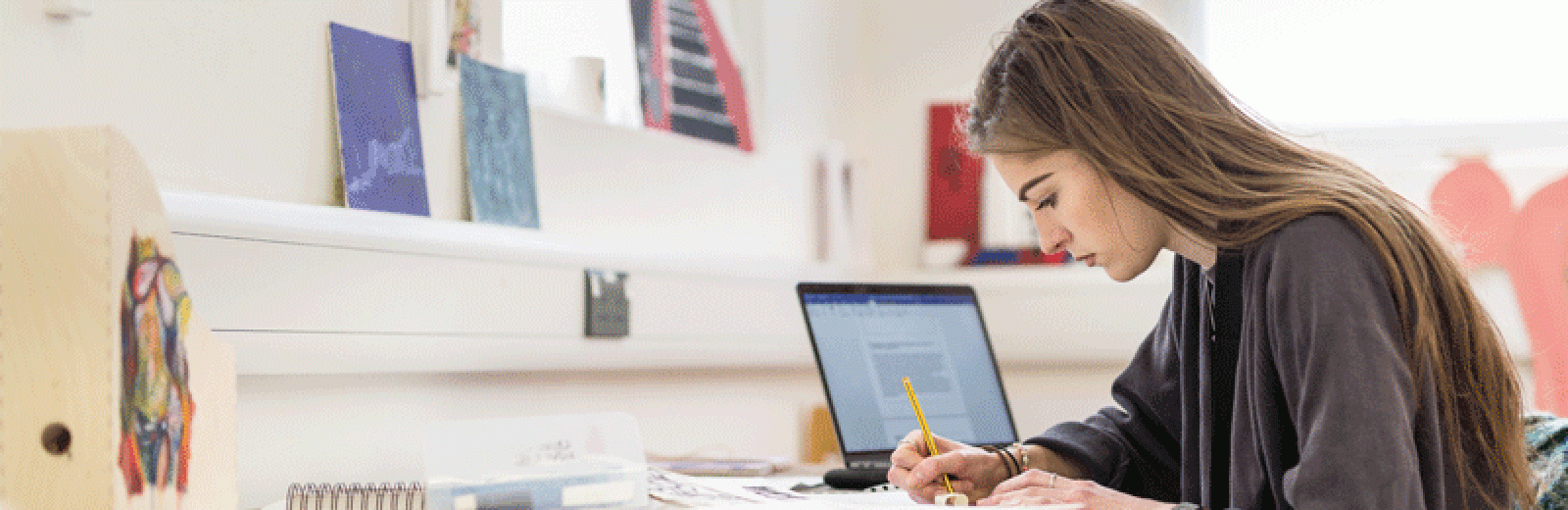
Fine Art with Contemporary Cultural Theory enables you to develop an independent art practice alongside skills in cultural theory and critical analysis. You will be supported to approach art as a way of critically thinking through and intervening in the contemporary world. You’ll explore cultural production and practices in national, transnational and global contexts and across subject areas including philosophy, literature, sociology, film, communication studies, art history and digital humanities.
As with all Fine Art undergraduate courses at Leeds, you will be encouraged to explore and challenge your idea of art, experiment across different media and undertake original research. You’ll have opportunities to contribute to the creative community, to build networks in the city and to exhibit your work regularly. You’ll be encouraged to investigate the interconnections between art and the larger social dynamics that shape our culture, such as ethnicity, class, gender, sexuality, being human and our relationship to nature and the environment. We’ll prepare you to be a socially conscious graduate with an array of relevant and transferable skills. You’ll have opportunities to contribute to the creative community, to build networks in the city and to exhibit your work. Throughout the course, we’ll support you in discovering what kind of creative practitioner and cultural theorist you want to be.
Our exemplary Year in Industry programme has enabled students to undertake work placements in the UK and internationally, with some placements leading to permanent employment in the arts sector, while our Study Abroad programme has provided life-changing experiences for many in our community.
Our Fine Art courses are distinct, with art historians, cultural theorists and fine artists studying alongside each other within a Russell Group University. The School building provides purpose-built studio space, a project space, specialist technical workshops, and a shared student common room, with regular open studio and exhibition events, opportunities for student-led social events and access to the city’s artistic scene.
Specialist facilities
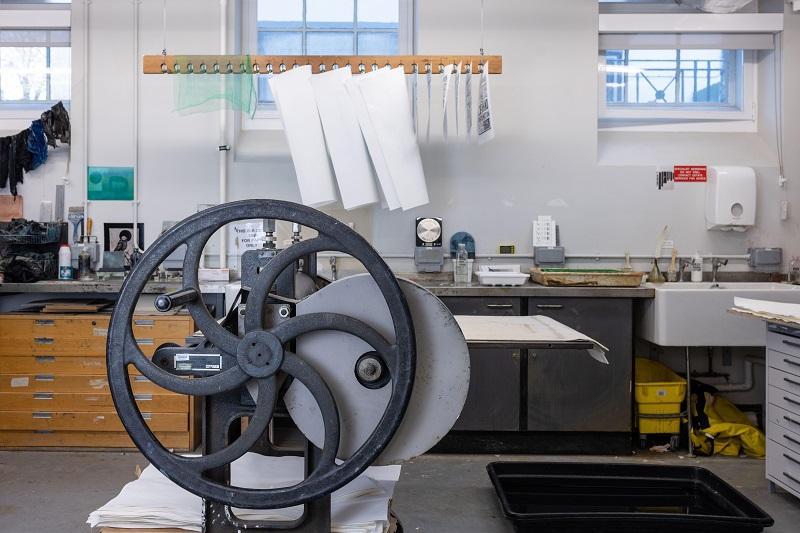
The School has excellent facilities and resources including:
The Project Space – a professionally fitted exhibition space, suitable for all media
dedicated Mac and PC computer suites for audio production, video editing animation and image manipulation
printmaking workshops for etching, relief and screen printing
a photography darkroom for film developing and printing
casting and ceramics workshop, including kiln facilities
a woodworking area
digital and 3D printing
In addition to the wide range of museums and galleries in the city and beyond, the University campus features:
Course details and modules
From the start of the course, you are encouraged to find your own direction as an artist. You'll split your time equally between studio practice and the theory and analysis of culture.
The course combines lectures with group seminar sessions, workshop activity and studio based teaching to explore contemporary art practice and help you contextualise your own creative work. You will have opportunities to engage with contemporary artists, writers, curators and other arts professionals, and gain professional practice experience to help you thrive within the wider art world and creative sectors.
Year 1
From the moment you arrive with us, you’ll be addressed as an emergent artist working as part of a shared community. The 'Introduction to Practice' and ‘Developing Practice’ modules will open up creative possibilities and explore various media and concepts to develop your own creative portfolio. You undertake a range of skills workshops that support your choices for a creative future.
As a Fine Art with Contemporary Cultural Theory student, you will undertake core modules in Fine Art Practice and Cultural Theory. You will be introduced to key themes and interpretive methods, in order to consider the nature of cultural analysis, and examine the relationships between art, culture and society.
Year 2
Now, you’ll think more deeply about being part of a community of artists. You’ll be expected to work with initiative in the studio, to build upon and critically apply the knowledge and skills learned in your first year and further pursue your own individual interests. Compulsory and optional modules will deepen your understanding of the complex relationship between visual cultures, history and society, and encourage you to think conceptually about art and cultural objects and practices. You will continue to develop your individual practice, which will be explored and developed throughout the year.
Open studios and exhibition opportunities will structure your artistic production. By the end of this year, you can opt to take a third-year work placement, study abroad or get ready for your final Degree Show year.
Year 3
In this final year, you will consolidate your individual practice, culminating in planning and organising a public exhibition, the degree show.. You will have full authorship of this project, where you can apply your artistic and professional skills. You will be supported to develop your awareness and understanding of the complex and diverse nature of contemporary practice through professional practice activity and self-directed research, consolidating the practical and intellectual skills that you have developed in years one and two. A significant element of your final year is your dissertation, in which you apply your research and critical skills to an independent piece of research on a topic of your choice, which can either complement your art practice or focus on a topic arising from your theoretical study. You can complement and support these projects with optional modules.
Course structure
The list shown below represents typical modules/components studied and may change from time to time. Read more in our terms and conditions.
Year 1
Compulsory modules
Introduction to Practice (40 credits) - You’ll be given the chance to explore contemporary and traditional approaches to fine art across a range of disciplines, making use of our excellent resources, including, film, experimental printmaking, ceramics, art writing, sculpture, photography and audio-visual practices.
You’ll be introduced into the broader context of contemporary art practices, engaging with artists, tutors and curators through practical studio workshops, live projects and exhibition opportunities. You’ll begin to develop the skills to discuss and analyse contemporary art as well as deepening your understanding of art history and critical theory.
You'll be introduced to the fundamental skills for developing your own exciting body of work while building critical awareness of the spaces, institutions, social practices and networks in which art is produced and disseminated.
Developing Practice [2] (40 credits) - This module continues with the development of independent studio work for developing self-directed practice-based research. You’ll be encouraged to develop artwork that reflects your research interests and locates your work within the contextual framework of contemporary art practice.
You’ll work in self-selected groups as you develop an independent practice and work towards a public presentation of your work.
Introduction to Cultural Analysis 1 (20 credits) - This module introduces ways of reading different aspects of culture. It should enable you to discuss the full range of cultural forms including film, television, popular literature and music as well as more canonical modes of culture such as opera, philosophy, art and architecture. This module will equip you with the skills to appreciate, criticise, and understand culture through intellectual approaches. This module covers questions of cultural studies, representation, authorship, meaning, close reading, ideology, race, sexual difference and psychoanalysis.
Introduction to Cultural Analysis 2 (20 credits) - This module introduces you to different methodological and critical approaches to the analysis and study of cultural production and consumption, in a range of different social, historical and political contexts. Week by week you are taken through a range of relevant questions, topics and themes relating to the critical and contextual analysis of culture and are shown the ways in which culture itself informs how it is theoretically interpreted.
Year 2
Compulsory modules
Defining your Practice [3] (20 credits) - This module builds on your achievements of the previous year as you take on your own studio in a shared communal studio space. The emphasis is on independent, self-directed, practice-based research and continuing to address questions of its dissemination, presentation and audience. You’ll develop your work supported by individual tutorials, group crits and technical workshops that allow you to explore processes, materials and technologies available to realise your creative aspirations and support the development of your professional practice.
Practice into Public Contexts [4] (40 credits) - Working in research focused studio groups, you’ll develop a body of work that explores your ideas of audience in relation to appropriate methods of display for your work, building your awareness of the social and cultural contexts, networks and histories that inform contemporary art’s production and presentation.
This module will be supported by individual tutorials and group crits, that continue to support your analytical approach to your own work and that of your colleagues. Specialist Technical workshops will allow you to continue to explore a range of processes, materials and technologies in order to realise your creative aspirations.
Optional modules
Image, Music, Text: Reading Roland Barthes (20 credits) - This module offers a detailed encounter with the work of Roland Barthes, and provides, more generally, an introduction to structural linguistics, critical semiology and its poststructuralist afterlife. Taking its cue from Barthes’ extreme attentiveness to language in the broadest sense of the word, the module explores important philosophical questions of thought, meaning, art, culture and human relations. The module follows the arc of Barthes’ work, from the rigour of his structuralist phase, with its eye-opening revolutionary insights into the structure of language and cultural systems, to his more personal and open-ended later writing, which both extends and critiques the strictly semiological approaches.
The State of Utopia (20 credits) - This module offers you the opportunity to explore a multitude of different ideal cities and model communities from the sixteenth century to the present day. The tracing of the various forms utopianism has adopted since Thomas More will take us into the fields of architecture, art, literature, politics, philosophy, sociology, women's studies and religion. In parallel to this historical approach to utopian thinking, you’ll be encouraged to think critically and imaginatively about our contemporary society and to propose a theoretically informed utopia for the future. The study of dystopias (failed social experiments) will be an unavoidable component of this module.
Live Issues and Contemporary Art Practice (20 credits) - You’ll consider how cultural theory and contemporary aesthetic practice critically engage with current social and political issues. Focussing on two “live issues” for five weeks, you’ll be encouraged to focus on subjects that incisively bear on what it might mean to be alive in the 21st century. Both issues will be framed with an appropriate theoretical framework that introduces you to the complexity of the topics being addressed. The “issues” focussed on will vary so to reflect recent works and current exhibitions.
Bodies of Difference: Gender, Power and the Visual Arts (20 credits) - This module explores a range of feminist, postcolonial and queer theories of the embodiment of gender, its performance, performativity and representation in art and visual culture, showing the relations between the two. You’ll address shifts in the representational schema of the woman's body by the study of a range of feminist perspectives that offer a critical framework for thinking about the body, embodiment and difference in all its intersectional complexity. This module also covers a range of theories and concepts that are vital to our understanding of the power and dynamics of gender and the body that are operative in art history and visual culture. It is in this sense that we will move toward the recent critical feminist theories and art practices that have revisited and challenged the conventions and representations that encoded ‘woman’ as the image of desire.
Seeing in Asia (20 credits) - Are there fundamental differences between the ways you see familiar objects and those from Asia? Are there ways in which the power and meanings of 'seeing' change in an Asian context, so that even though we are 'seeing' the same object, we understand the object differently? How do cultural and historical values and standards shape the act of seeing and how we interpret images? By engaging with wide-ranging historical and cultural examples drawn from a range of specialities from art to science, this module addresses the age-old problem of ‘nature’ versus ‘nurture’ through the perspective of Asian Culture.
Showing Asia (20 credits) - This module focuses on the historical practice of collecting and exhibiting Asian objects, both within and outside Asia. It offers you a thematic survey of the history of engagements that displayed “Asian” cultures from 19th century to today by exploring wide-ranging primary sources from catalogues of Crystal Palace exposition to internet home pages. You’ll analyse the interconnected ways through which political and social forces shape the access to and formation of knowledge of art in/of Asia.
State of the Art: Contemporary Perspectives in Art, Science and Technology (20 credits) - This module explores how art and curatorial practice can offer an investigative lens on scientific and technological innovation. You’ll engage with and challenge the logic of art as a medium for the communication of science and consider the collaborative potential within these fields and the reciprocal dialogue between artistic and scientific methods and practices. Through discussion of contemporary issues in art, science and technology, you’ll be encouraged to critically reflect on the socio-political context of current debates and the ethical implications of their treatment in curated settings.
Year 3
Compulsory modules
Practice towards exhibition (60 credits) - In this module, you’ll continue to develop your research-driven creative practice to produce a highly consolidated body of work and apply critical skills to its presentation. By the end of the module, you’ll have gained advanced technical skills in your chosen media and a highly critical understanding of contemporary art practice and its history. The focus is towards the public platform of the degree show exhibition. In addition to exhibiting, you’ll have the opportunity to volunteer on the curatorial organising group and to gain invaluable experience of planning and delivering a large-scale group exhibition. Our artistic community has full authorship of their degree show, while being supported by our specialist technicians, academic staff and the University marketing team.
Dissertation (40 or 60 credits) - The aim of a dissertation is to foster your own independent research and scholarship alongside your studio practice, by identifying appropriate critical, historical and theoretical frameworks for your chosen subject. Your project is supported by a dedicated dissertation supervisor who is aligned with your research interests. You might use this arts-based research opportunity to further your own practice concerns, helping you to address critical cultural questions, or material concerns, future practice options or to identify new forms of knowledge that will support you in your future career plans or to launch further study in an MA or similar further postgraduate study programme.
Optional modules
If you choose the 40 credit Dissertation option, you will be able to take one 20 credit Optional Module.
From Trauma to Cultural Memory: The Unfinished Business of Representation and the Holocaust (20 credits) - This module addresses debates in literary, historiographical and psychological theory about the ways in which witnesses provide testimony, and the ways in which the legacy of a historical trauma of the magnitude of the Holocaust is represented by historians, sociologists, writers, artists and museums. Rather than a historical study of the events of 1933-45, you’ll consider the continuing significance of this disaster in the larger context of European history. You’ll pay close attention to the voices and images of those who continue to live with a trauma that only psychological, analytical, creative work can turn into memory, which the cultures of Europe must take on as the history that continues to shape our present responses to all forms of racism, genocide and violence against the stranger.
Cultural Diversity in Museum and Material Culture - Case Study (20 credits) - Museums are increasingly conscious of the need to be socially inclusive. Traditional models of privileging high art and 'white western' art have come under sharp criticism. In this module, you’ll examine how museums have integrated (or failed to do so) the artefacts of the Jewish minorities in Europe and the USA. You’ll look at the historical reasons for the omission of Jewish culture from many museums, and the particularities of the models adopted for Jewish museums and Jewish exhibits in ethnographic and local history contexts.
Critical Approaches to Photography (20 credits) - Photographic images saturate every corner of contemporary society in a developed country to such an extent that it is difficult to spend a day without seeing a photographic image. Yet, the popular concepts in discussions of photography remain overused and unexamined at best ('truth' 'reflection' 'index'). By engaging with historical and cultural treatises about the medium and its property (how photography 'reflects' reality, how photographers 'see' differently, for instance) this module excavates the multiple layers of philosophical issues embedded in concepts such as 'truth,' 'reality' and 'mediation' in thinking about and writing about photographic images.
Postcolonial Feminisms (20 credits) - You’ll examine feminist theory and politics, as they have developed in the context of the period of decolonization and its wake. Emphasis will fall on theoretical formulations concerning sexual difference and the social division of gender as these have been produced by women writing to or from former European colonies. Attention will also be given to questions posed by and for feminism within postcolonial metropoles.
Movies, Migrants and Diasporas (20 credits) - This module is dedicated to migration and diaspora in Europe as reflected in the cinema. It introduces you to the work of filmmakers with, for example, German Turkish, Black or Asian British, Maghrebi French, Roma or Jewish backgrounds, productions made by transnational Eastern European practitioners and films about migration and diaspora created by non-migrant/diasporic writers and directors.
Learning and teaching
Learning and teaching is delivered within a collective community environment, where shared interests and aims can be explored to embrace an inclusive sense of belonging and ownership. Mutual support and collaboration are openly encouraged.
Studio tutors are practising artists, writers and curators who are contributing to national and international exhibitions and publications. Their research informs and contextualises your learning and teaching.
This course combines studio, exhibition and curatorial work, with traditional teaching and learning methods such as lectures, seminars, studio crits, tutorials and workshops. You’ll also have the chance to enhance your knowledge and learning by attending talks from nationally and internationally renowned visiting artists and creative practitioners, as well as attending exhibitions and conferences both on and off campus.
Independent study is a vital element of this degree, allowing you to develop your creativity and build important skills in areas such as research, analysis and interpretation.
We encourage you to carry out small research projects, on your own or as part of a group. The final-year dissertation enables you to undertake substantial independent research in a topic of particular interest to you.
We encourage you to carry out small research projects on your own or in groups. The final year dissertation enables you to undertake substantial independent research in a topic of particular interest to you.
On this course, you’ll be taught by our expert academics, from lecturers through to professors. You may also be taught by industry professionals with years of experience, as well as trained postgraduate researchers, connecting you to some of the brightest minds on campus.
Assessment
We use a combination of assessment methods that allows you to develop diverse skills. These include your studio work, essays and exams, depending on the modules you have selected to study.
Assessment is led by principles of relevance, fairness and inclusivity, and the development of vital skills beyond university, such as problem-solving, adaptability, self-reliance and reflexivity.
Practice modules, across the three years of study, are assessed by the submission, at the end of each module, of a single PDF portfolio and supporting statement.
Entry requirements
A-level: ABB
Other course specific tests:
Where an applicant is undertaking an Extended Project Qualification (EPQ), the School may make an alternative offer that is one A level grade below that of our standard offer – on the condition that the applicant achieves a grade A in their EPQ (e.g. ABB at A level / alternative offer BBB plus grade A in EPQ).
NB: An EPQ is optional and not a requirement of application.
Applicants already studying a Fine-Art related subject at Level 3, or undertaking Access to Leeds (please note you must meet the criteria for this) will not be required to submit a portfolio.
Applicants who are not taking a Fine-Art related subject at Level 3 will be required to submit a satisfactory portfolio of work.
Alternative qualifications
Access to HE Diploma
Pass with 60 credits overall including 45 credits at Level 3, of which 30 credits must be at Distinction and 15 must be at Merit level.
BTEC
DDM
Example combination offers:
Distinction in BTEC Extended Certificate/Subsidiary Diploma plus BB in two A Levels or Merit in BTEC Extended Certificate/Subsidiary Diploma plus AA in two A Levels
Distinction Distinction in BTEC Diploma plus C at A Level or Distinction Merit in the BTEC Diploma plus A at A Level
Cambridge Pre-U
M1, M1, M2
International Baccalaureate
34 points overall including 16 at Higher Level with 4 in English
Irish Leaving Certificate (Higher Level)
H2, H2, H2, H3, H3, H3
Scottish Highers / Advanced Highers
BB in Advanced Highers and AABBB in Highers OR B in Advanced Highers and AAABB in Highers OR AABBBB in Highers
Welsh Baccalaureate
WJEC Level 3 Advanced Skills Baccalaureate Wales is accepted in place of a third A-level subject at the same grade. For example: we require two A-levels at grade AB, plus your Level 3 Advanced Skills Baccalaureate Wales at grade B. (excluding General Studies and Critical Thinking)
Other Qualifications
Art Foundation Diploma: Merit or higher with A-level: Grade A (any subject considered other than Critical Thinking or General Studies).
UAL Extended Diploma: Distinction (or High Merit where available).
European Baccalaureate: 75%
Read more about UK and Republic of Ireland accepted qualifications or contact the School’s Undergraduate Admissions Team.
Alternative entry
We’re committed to identifying the best possible applicants, regardless of personal circumstances or background.
Access to Leeds is a contextual admissions scheme which accepts applications from individuals who might be from low income households, in the first generation of their immediate family to apply to higher education, or have had their studies disrupted.
If you live in a neighbourhood where there is low participation in higher education, we may be able to give priority to your application.
Find out more about Access to Leeds and contextual admissions.
Arts and Humanities with Foundation Year
This course is designed for students whose backgrounds mean they are less likely to attend university (also known as widening participation backgrounds) and who do not currently meet admissions criteria for direct entry to a degree.
The course will give you the opportunity to be taught by academic staff and provides intensive support to enable your development of academic skills and knowledge. On successful completion of your foundation year, you will progress to your chosen degree course. Find out more about the Arts and Humanities with Foundation Year
International
We accept a range of international equivalent qualifications. Contact the Undergraduate Admissions Office for more information.
International foundation year
International students who do not meet the academic requirements for undergraduate study may be able to study the University of Leeds International Foundation Year. This gives you the opportunity to study on campus, be taught by University of Leeds academics and progress onto a wide range of Leeds undergraduate courses. Find out more about International Foundation Year programmes.
English language requirements
IELTS 6.0 overall, with no less than 5.5 in any component. For other English qualifications, read English language equivalent qualifications.
Improve your English
If you're an international student and you don't meet the English language requirements for this programme, you may be able to study our undergraduate pre-sessional English course, to help improve your English language level.
Fees
UK: £10,050
International: £27,300 (per year)
The amount of tuition fees you pay is based on whether you are classified as a home (UK) or international student. Find out how we assess your fee status.
Tuition fees for UK students
Tuition fees for UK undergraduate students starting in 2027/28 are £10,050.
Subsequent years
The UK government sets the maximum tuition fee caps that universities can charge UK students. This means your tuition fee in future academic years will reflect any changes set by the government.
From 2028/29 onwards, tuition fees are likely to increase annually, at least in line with inflation, and may rise further if the government increases the fee cap.
Tuition fees for international students
The international fee applies for each year of full-time study and will remain the same for the duration of your course.
Read more about tuition fees.
Tuition fees for a study abroad or work placement year
If you take a study abroad or work placement year, you’ll pay a reduced tuition fee during this period. For more information, see Study abroad and work placement years on our tuition fees page.
Additional cost information
There may be additional costs related to your course or programme of study, or related to being a student at the University of Leeds. Read more on our living costs and budgeting page.
Scholarships and financial support
If you have the talent and drive, we want you to be able to study with us, whatever your financial circumstances. There is help for students in the form of loans and non-repayable grants from the University and from the government. Learn more about undergraduate funding.
Scholarships are also available to help fund your degree. Find out more and check your eligibility below:
Applying
Apply to this course through UCAS. Check the deadline for applications on the UCAS website.
Digital portfolio
Applicants will be required to submit a satisfactory digital portfolio of work unless you are already studying a Fine-Art related subject, or undertake Access to Leeds (please note you must meet the criteria for this).
What is a digital portfolio?
A digital portfolio is a PDF file that shows images of your artwork alongside notes, research and any relevant writing.
It’s your opportunity to show us the work you have been making, what you are interested in, and how you explore ideas and creative processes and materials.
Why do I need to submit a portfolio?
Submitting a portfolio helps us understand what inspires you, what you care about, and how you use different materials and techniques to bring your ideas to life.
What should I include in my portfolio?
Show us the work you're most excited about—this can be work done at school or college or work you've done independently.
Show us different media you have used - drawings, collages, paintings, prints, assemblages, installations, sculpture, photography, film, animation, pages from sketchbooks, documentation of performances—whatever best represents you.
Pick pieces that reveal your creative process, interests, and willingness to experiment. You can also include unfinished pieces.
5–6 strong pieces can highlight your range, but there’s no set number.
Feel free to include writing - like personal statement excerpts that show your passion for art and why you are motivated to study Fine Art.
When we look at your portfolio, we will consider 4 key areas:
Methods: Show us examples of work you have created using different methods of making. This could include experimenting with different materials, processes and technologies. Show us how you have tested different methods of thinking and making.
Contexts: Show us how your work connects to the world around you and your personal experiences. If you’ve shown your work somewhere, tell us why that space mattered. If there are references from contemporary art or art history, exhibitions, film, reading material and literature that are important to you, share them with us.
Research: Show us how your ideas take shape. Share sketches, tests, unfinished work—even the work that didn’t go to plan. Let us see how you explore through making, reading and researching. Add notes or captions to explain what you were thinking and what you discovered.
Presentation: Pick clear, well-lit photos that show off your work. Think about the order of your images—tell a story with them. Use close-ups to highlight textures and details, and feel free to show different angles of the same piece.
Can I see an example portfolio?
View an example portfolio here (PDF)
Portfolio checklist:
Your portfolio should be a single PDF with a maximum document size of 30MB.
Include a cover page that contains your full name and the course you’re applying for.
Your portfolio can contain up to 10 pages, including the cover page. Multiple images can be on a single page but do make sure we can clearly see the work.
If you are working with moving image, you can include links to videos on platforms like YouTube or Vimeo. Make sure you include a full URL for any links and provide any passwords for access. Moving image works should be single works, not video versions of other supporting material or showreels of multiple works
Make sure to include captions for all your images. These should include the title, year, materials used and the size of the work. Here is an example of an image caption:
Imprint sequence, 2026, intaglio etching on paper, 24 x 52cm
The portfolio is mainly a visual document, but you can also include short notes and other extracts of writing that support your work. 200-300 words is a helpful word count to keep in mind, and can be included as either a single paragraph or smaller sections of writing alongside your images. Expanding your image captions is one way of doing this.
How do I submit my portfolio?
After you apply, we will contact you to let you know how to submit your portfolio and give you a date to submit this by.
If you have questions about your portfolio, please contact our Admissions Team via email at finadm@leeds.ac.uk who will be able to help.
What happens next?
After you have submitted your portfolio, you should expect to receive an offer decision via UCAS Track within three to four weeks of submission. If you do not, please contact our Admissions Team via email at finadm@leeds.ac.uk to make further enquiries, making sure you quote your name, course and UCAS ID number.
Read further guidance about applying to this course.
International students apply through UCAS in the same way as UK students. Our network of international representatives can help you with your application. If you’re unsure about the application process, contact the admissions team for help.
Read about visas, immigration and other information in International students. We recommend that international students apply as early as possible to ensure that they have time to apply for their visa.
Admissions policy
University of Leeds Admissions Policy 2027
This course is taught by
School of Fine Art, History of Art and Cultural Studies
Contact us
School of Fine Art, History of Art and Cultural Studies Undergraduate Admissions
Email: finadm@leeds.ac.uk
Career opportunities
We have a strong commitment to enhancing student employability and embedding transferrable skills that are extendable into a range of careers. Our graduates become ambitious and pioneering artists, curators, critics, journalists and innovative initiators working across a wide range of creative fields.
Many of our graduates combine careers as artists with work in education, museums and galleries and art therapy. Others use their knowledge and skills to launch careers in fields including journalism, broadcasting, marketing, technology, business or design. Our graduates have gone on to postgraduate study including fine art, curating and museum studies, arts marketing, art and business, art and design PGCE, interactive design, gaming, animation and art and ecology. Many have completed PhDs and are teaching in higher education institutions around the world. As a School we have an engaged research community made up of MA and PhD students working across fine art practices, art history, cultural studies, gallery, museum and heritage studies.
We are dedicated to helping you achieve your career ambitions - you'll be able to work closely with our exhibiting and research active staff in the School to source opportunities to gain experience, develop your skills and build networks. The optional Study Abroad or Year in Industry also offers opportunities to gain transferable skills, develop your experience and create strong working relationships.
Leeds for Life is our unique approach to helping you make the most of university by supporting your academic and personal development. Find out more at the Leeds for Life website.
The Careers Centre and staff in your faculty provide a range of help and advice to help you plan your career and make well-informed decisions along the way, even after you graduate. Find out more at the Careers website.
For my dissertation I was able to choose a research area related to the career that I would like to pursue after university. Through this research project I had the opportunity to make professional contacts within arts events management.
- Imogen Dunkley, Fine Art with CCT
Top 10 most targeted for 10+ years
by the UK's leading employers
The Graduate Market 2026, High Fliers Research
Careers support
At Leeds, we help you to prepare for your future from day one. We have a wide range of careers resources — including our award-winning Employability Team who are in contact with many employers around the country and advertise placements and jobs. They are also on hand to provide guidance and support, ensuring you are prepared to take your next steps after graduation and get you where you want to be.
Employability events — we run a full range of events including careers fairs in specialist areas and across broader industries — all with employers who are actively recruiting for roles.
MyCareer system — on your course and after you graduate, you’ll have access to a dedicated careers portal where you can book appointments with our team, get information on careers and see job vacancies and upcoming events.
Qualified careers consultants — gain guidance, support and information to help you choose a career path. You’ll have access to 1-2-1 meetings and events to learn how to find employers to target, write your CV and cover letter, research before interviews and brush up on your interview skills.
Opportunities at Leeds — there are plenty of exciting opportunities offered by our Leeds University Union, including volunteering and over 300 clubs and societies to get involved in.
Study abroad and work placements
Our exemplary Study Abroad programme enables you to undertake formative and exciting year-long study in year three, with our partner universities all over the world. You’ll be able to choose from an array of institutions and benefit not only from different approaches to art teaching and making, but cultural experiences and new friends that could transform your life forever, graduating with a BA Fine Art with Contemporary Cultural Theory (International) degree. Universities and art schools recently chosen by our students for their study abroad year include:
Find out more at the Study Abroad website.
I went on a year abroad to Toronto, and had an amazing experience. I gained inspiration for my art practice and I now know that I could live anywhere in the world if I wanted to – it gave me so much confidence.
- Alex Oliver, BA Fine Art with History of Art
This programme gives you the opportunity to undertake an industrial placement year as part of the course.
It’s important to note, work placements are not guaranteed. The job market is competitive – and there may be competition for the placement you want. You’ll have to apply the same way you would for any job post, with your CV and, if successful, attend an interview with the organisation.
Our Employability Team will help you every step of the way. They run a number of placement sessions to discuss opportunities and support you with CV writing and interview preparations. Plus, they’ll be there to answer any questions you may have and offer guidance throughout the process, too.
Benefits of a work placement year:
100+ organisations to choose from, both in the UK and overseas
Build industry contacts within your chosen field
Our close industry links mean you’ll be in direct contact with potential employers
Advance your experience and skills by putting the course teachings into practice
Gain invaluable insight into working as a professional in this industry
Improve your employability
Find out more about Industrial placements.
Our exemplary Year in Industry programme has led to students successfully undertaking work-based placements locally and internationally, some of which have led to permanent full-time employment after graduation. On undertaking this opportunity, students will graduate with a BA Fine Art with Contemporary Cultural Theory (Industry) degree. Recent placements include; Archival assistant at Chert Ludde Gallery, Berlin; Social Media assistant at CeeCee, Berlin; Arts PR Consultancy with Bolton & Quinn, London; Marketing assistant, L’Oreal, UK; Programme Assistant at Oris House of Architecture, Croatia and Palazzo Monti Artist Residency, Italy; Gallery assistant at Wychwood Gallery, UK; Assistant Producer at Limehouse Film Production, Leeds; Gallery Assistant at ArtDog London & Nahmed Gallery, London; Marketing role with Adobe Design Projects.