Course overview
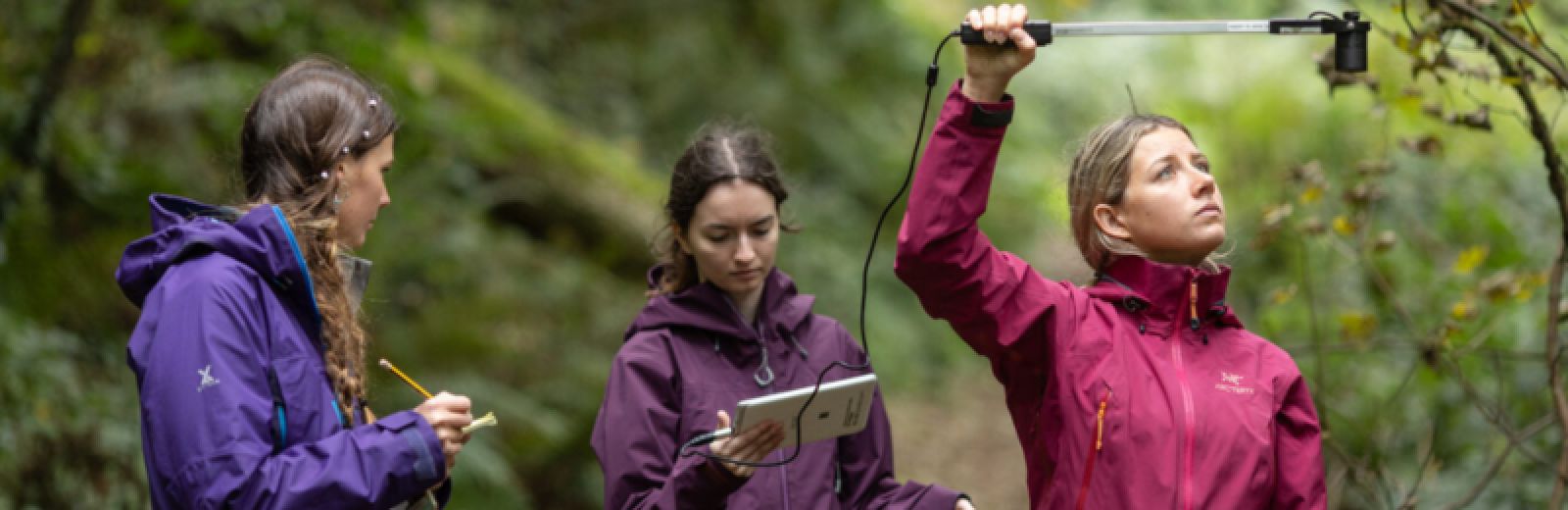
Discover how you can forge a career out of protecting the environment from a range of threats.
Environmental scientists often work on the front lines against climate change and pollution, identifying and combatting risks to the air we breathe, the water we drink and the land we live on.
It’s their job to monitor air, water and soil quality and assess impacts from biodiversity loss and climate change. They then design solutions to minimise these effects and promote a healthier, more sustainable world for all living beings.
On our Environmental Science degree, you’ll develop your knowledge of the Earth’s interconnected environmental systems. You’ll then understand the social factors that lead to local and global environmental issues, before exploring how we can fix them.
You’ll learn from one of the UK’s largest environmental and Earth science schools, drawing from internationally recognised tutors with a wide range of expertise.
You’ll explore how to become an environmental scientist, as you collect, analyse, evaluate and communicate environmental monitoring data. You’ll also get the chance to engage in uncharted science through an independent research project in your final year.
By the time you graduate, you’ll have the expertise to challenge conventional thinking and help safeguard our environment for all who live here.
The department has such an enormous array of sub-topics and modules to explore, you can never be sure what you will and won’t like. Chances are, something amazing is waiting to be discovered by you.
Why study at Leeds
- A professionally accredited programme: This course is accredited by The Institution of Environmental Sciences.
- Engage with world-leading research: Our globally renowned research tackles complex global challenges, such as climate change, energy security and natural hazard management, feeding directly into your course and shaping your learning with the latest thinking.
- Learn from expert tutors: Experience expert teaching from leading specialists with extensive experience across the breadth of environmental science.
- Access excellent facilities: Access excellent specialist facilities, including lecture theatres, seminar rooms and computer clusters fully equipped with the latest technology to support your learning.
- Put theory into practice: Undertake fieldwork activities, where you’ll advance your research skills and gain hands-on experience that’s highly valued by employers in industry or in postgraduate education.
- Broaden your prospects: Enhance your career prospects and give your CV that competitive edge with our exciting study abroad programmes and work placement opportunities.
Accreditation
Accreditation is the assurance that a university course meets the quality standards established by the profession for which it prepares its students.
This course is accredited by the Institution of Environmental Sciences (IES), so you can be assured that it:
- meets highly professional standards
- contains a strong component of practical, field and theoretical activities
- features excellent opportunities for training, work experience and building contacts within the professional environmental sector
You'll also be eligible for free student membership of IES and a fast-track route to membership once you graduate, starting you on a route towards becoming a Chartered Environmentalist or Chartered Scientist.

Course details and modules
This course covers a broad range of environmental issues covering the geosphere, atmosphere, hydrosphere, cryosphere and biosphere, allowing you to tailor your degree to your interests.
Discovery modules are available in all years of your degree, as long as you're not required to take all the foundation science modules in year 1 and are taking enough credits of your own core subject each year.
Fieldwork will also be integral to your course, with opportunities to explore many places.
Please note: field trip destinations specified below are typical examples but may be subject to change.
Each academic year, you'll take a total of 120 credits.
Course Structure
The list shown below represents typical modules/components studied and may change from time to time. Read more in our terms and conditions.
Most courses consist of compulsory and optional modules. There may be some optional modules omitted below. This is because they are currently being refreshed to make sure students have the best possible experience. Before you enter each year, full details of all modules for that year will be provided.
Year 1
You’ll explore all the principles that underpin the broad subject matter of the environmental sciences. The core level 1 environmental science modules will form the basis of your degree studies and cover the fundamentals of the biosphere, the hydrosphere, the atmosphere and the geosphere and how human civilisation and society interacts with each.
Alongside these core topical modules, you’ll also undertake training in academic and fieldwork skills, which includes academic writing, presentation, experimental design and coding. You’ll also undertake fieldwork in every year of your study at Leeds.
Compulsory modules
Fieldwork and Tutorials 1 (20 credits)
You’ll acquire study, practical and field-based skills suitable for the School of Earth, Environment and Suistainability, as well as learning academic writing and presentation skills and skills in computing for data analysis and visualisation.
Earth (10 credits)
You’ll receive an introduction to the Earth Sciences, learning about fundamental geological concepts and processes (dynamic Earth; plate tectonic theory; basic mineralogy and petrology; Earth history and palaeontology) and acquiring basic geological skills (rock and mineral identification; geological map interpretation).
Ecology (10 credits)
Study some of the key principles and theories of population, community and ecosystem ecology and explore these in relation to case study ecosystems.
Atmosphere (10 credits)
Be introduced to some fascinating phenomena in the Earth's atmosphere from the origin of life-sustaining air itself to present-day climate change. The module aims to present a diverse range of topics that are all related to Earth’s atmosphere.
Resources (10 credits)
You’ll learn about the variety of natural resources that are obtained from the Earth system and are essential to the functioning of our modern society. The module will cover methods of extraction, exploitation and sustainable practise as well as the many negative effects associated with the extraction of natural resources from the natural environment.
Water (10 credits)
Learn about the basic properties of water as a substance and why these make it a unique and important part of the Earth's environmental systems. By the end of the module, you'll have an understanding of the key role that water plays in our planet's atmosphere, oceans, ice and land surfaces.
Weather (10 credits)
This module is a general, non-mathematical, introduction to meteorology and weather forecasting. The course emphasises the basic physical concepts and processes that underlie our weather, explaining the nature of important features such as warm and cold 'fronts', depressions, cloud types, and the weather associated with them.
Optional modules (selection of typical options shown below)
- Foundation Chemistry (10 credits)
- Foundation Physics (10 credits)
- Foundation Mathematics 1 (10 credits)
- Advanced Mathematics 1 (10 credits)
- Natural Hazards (10 credits)
Year 2
You’ll continue to develop your key academic skills with the next level of the fieldwork and tutorials module as well as further refining your skills and building your knowledge via core modules focusing on environmental measurements in the field, and data analysis and visualisation using computer coding and GIS.
The second year gives you much more freedom of choice when it comes to topical modules. At this point, you can elect to specialise in one of two broad areas for the rest of your studies via the Applied Environmental Science or Earth System Science pathways.
Applied Environmental Science focuses on local- to regional-scale issues of human interactions with the environment, with a clear solutions-based approach to dealing with land contamination and remediation, as well as atmospheric pollution and managing biodiversity.
The Earth System Science pathway focuses on the Earth’s natural cycles and how humans influence them on a global scale. You’ll cover topics from climate change and meteorology to oceanography. The modules from each pathway are not mutually exclusive and it is possible to pick and choose a mix from each.
Compulsory modules
Fieldwork and Tutorials 2 (20 credits)
Building on skills developed at Level 1, this module aims to provide you with coherent and consistent training in skills needed for research project writing, as well as skills in employability relevant to pursuing a career in the in the environmental sector or with general graduate employers.
Environmental Measurements (20 credits)
This module is designed to prepare you for a significant research activity such as your Level 3 research project, and includes the techniques and theory behind experimental planning, sampling, measuring, analysing and interpreting data. The aim is to give coherent training all the way from experimental design through to the presentation of findings.
Data Analysis and Visualisation (20 credits)
This module aims to provide you with a core set of transferable computing and analytical skills to facilitate your transition from Higher Education study to the workplace and make you highly competitive in the pursuit of your chosen career.
GIS for Environmental Scientists (10 credits)
You'll cover the role of Geographic Information Systems (GIS) in curating, mapping and analysing environmental data and will allow you to develop skills with GIS techniques and software through examples of relevance to the environmental sciences. Such skills are valuable for both final year projects and in the workplace, where GIS software is widely used by many consultancy companies and other agencies for environmental mapping and modelling.
Optional modules through pathways (selection of typical options shown below)
Applied Environmental Science pathway options:
- Contaminated Environments (20 credits)
- Atmospheric Pollution from Local to Global Scales (10 credits)
- Managing Biodiversity (10 credits)
Earth System pathway options:
- Meteorology (10 credits)
- Introductory Oceanography (10 credits)
- Climate Change: Science and Impacts (10 credits )
Year 3
In your final year of study the only core modules are your independent dissertation Environmental Research Project, which accounts for a large part of your third year mark and allows you to study a topic of your choice under the supervision of an academic expert in the school who acts as your mentor and supervisor, and a skills-based module that focuses on the academic and field skills needed to support your research. In addition, you can further customise your degree to your own particular interests by choosing from a wide range of optional modules from the Applied Environmental Science and Earth Systems Science pathways and picking a further Discovery Module from a range offered across the university as a whole.
Compulsory modules
Environmental Research Project (40 credits)
On completion of this module, you’ll have developed original subject-specific knowledge in your chosen area and written it up in the form of a research-based dissertation, placing you in a position to contribute to related critical debate.
Fieldwork and Tutorials 3 (10 credits)
You’ll be trained in advanced practical environmental field skills and their expert application to research and industry problems. The module involves both a residential field course and a component of independent research that allows you to examine the observations made in the field in further depth, and critically evaluate your findings from an ethical perspective.
Optional modules (selection of typical options shown below)
Applied Environmental Science pathway options:
- Tropical Forests and Sustainable Development (20 credits)
- Environmental Risk: Science, Policy and Management (10 credits)
- Groundwater (10 credits)
- Atmospheric Pollution: Causes, Impact and Regulation (10 credits)
- Modelling Extreme Weather Events (10 credits)
- Geothermal energy: engineering, societal and governance challenges (10 credits)
- Engineering Geology (10 credits)
- Strategic Energy Issues (10 credits)
Earth System pathway options:
- Earth System Science: Biogeochemical Cycles (10 credits)
- Atmosphere and Ocean Climate Change Processes (10 credits)
- Ice in the Earth System (10 credits)
- Atmospheric Physics (10 credits)
- Terrestrial Biosphere in the Earth System (10 credits)
- Oceanography in the Earth System (10 credits)
- Observing Weather and Climate Advanced Skills (20 credits)
Fieldwork
Ask any of our students and they will tell you that taking part in fieldwork is one of the most enjoyable and memorable aspects of the course. We offer a range of increasingly sustainable fieldwork opportunities, giving you the chance to study a fascinating subject in contrasting environments away from the University.
Field teaching is integrated with lectures and module coursework, giving you the opportunity to:
- Practice the skills you have learnt in class in real-world situations.
- Gain first-hand experience of collecting and analysing environmental data.
- Build valuable individual and team research skills – vital for your final year research project.
- Develop professional skills sought after by employers like project planning, communication and teamwork.
- Get to know your lecturers and fellow students even better.
Our field trips are designed to be as sustainable as possible and balance their carbon footprint with the learning outcomes of the trip.
One-year optional work placement or study abroad
During your course, you’ll be given the opportunity to advance your skill set and experience further. You can apply to either undertake a one-year work placement or study abroad for a year, choosing from a selection of universities we’re in partnership with worldwide.
Learning and teaching
Most modules combine lectures with practicals, workshops or seminars, depending on the subject. These are enhanced with skill-focused classes, field trips and small group academic tutorials. You can expect to study in a variety of settings, from large lecture theatres to computer clusters, seminar rooms, tutorials, laboratories and out in the field. Our School is located in the centre of the campus and provides an ideal working environment, offering quiet study and coffee areas when you are not in class.
We offer research-led teaching across the breadth of our environment and natural science disciplines, from specialists in their field. As Leeds is a research-intensive Russell Group University, you’ll be studying amongst staff who are at the cutting edge of research worldwide, and who will incorporate this expertise into their teaching.
You’ll have a designated personal tutor throughout your studies at Leeds, who will be an academic member of staff. You’ll have regular academic tutorials with your tutor throughout your first two years, in your tutor group (of typically 5 students), as well as one-to-one meetings twice per semester. In addition, our excellent student support team is based close to where you’ll work and study to help with anything from academic advice to timetabling and project submission enquiries. You'll also receive support from fellow students through our peer mentoring scheme.
Taster lectures
Watch our taster lecture to get a flavour of what it’s like to study at Leeds:
Join our online taster course
Our two-week course introduces you to the processes of the hydrosphere, the geosphere, and the biosphere, as you explore the impact of human activity and climate change on our planet.
Programme team
On this course, you’ll be taught by our expert academics, from lecturers through to professors. You may also be taught by industry professionals with years of experience, as well as trained postgraduate researchers, connecting you to some of the brightest minds on campus.
Assessment
You'll be assessed through a variety of methods, specifically designed to help you learn, whatever your preferred learning style. We use both coursework and exams, but with a general progression from an emphasis on exams in year 1 towards an emphasis on coursework in your final year.
Entry requirements
A-level: ABB including two from: Biology, Chemistry, Computer Science, Environmental Science, Further Mathematics, Geography, Geology, Marine Science; Mathematics, Physics, Statistics.
Where an A-Level Science subject is taken, we require a pass in the practical science element, alongside the achievement of the A-Level at the stated grade.
GCSE: English Language and Mathematics at grade 4 (C) or higher, or an equivalent English language and Mathematics qualification. We will accept Level 2 Functional Skills English instead of GCSE English.
Extended Project Qualification, International Project Qualification: Grade A plus BBB at A-level.
Alternative qualifications
Access to HE Diploma
Pass 60 credits overall with 45 credits at Level 3, 30 credits with Distinction and the remaining 15 credits with Merit or above. The A2HE diploma must cover modules aligned with the subjects named in the A-level section.
BTEC
DDM in National Extended Diploma. We can also accept a combination of National Extended Certificates and A-levels. The BTEC, with or without combination A-levels, must cover modules aligned with the subjects named in the A-level section.
Cambridge Pre-U
D3, M2, M2 including two relevant subjects.
International Baccalaureate
6,5,5 at higher level including two relevant subjects.
Irish Leaving Certificate (Higher Level)
AABBBB/H2H2H3H3H3H3 including two relevant subjects.
Scottish Highers / Advanced Highers
AABBB overall with BB in 2 Advanced Highers (AH). For non-AH applicants AABBBB. To include 2 relevant subjects.
T-Levels
We do not accept T Levels as entry onto this course. You might be considered for entry to one of our foundation year courses.
Welsh Baccalaureate
Welsh Baccalaureate Advanced Skills Challenge Certificate: We will accept the Advanced Skills Challenge Certificate in lieu of a third A-Level at the same grade, assuming any subject specific requirements are met using alternative qualifications.
Read more about UK and Republic of Ireland accepted qualifications or contact the School’s Undergraduate Admissions Team.
Alternative entry
We’re committed to identifying the best possible applicants, regardless of personal circumstances or background.
Access to Leeds is a contextual admissions scheme which accepts applications from individuals who might be from low income households, in the first generation of their immediate family to apply to higher education, or have had their studies disrupted.
If you live in a neighbourhood where there is low participation in higher education, we may be able to give priority to your application.
Find out more about Access to Leeds and contextual admissions.
Typical Access to Leeds A Level offer: BBC including two of the required subjects plus a pass in the Access to Leeds scheme.
For alternative qualification offers please contact the admissions team.
Foundation years
If you do not have the formal qualifications for immediate entry to one of our degrees, you may be able to progress through a Foundation Year. A Foundation Year is the first year of an extended degree. We’ve designed these courses for applicants whose backgrounds mean they are less likely to attend university and who don’t meet the typical entry requirements for an undergraduate degree.
We offer a Studies in Science with Foundation Year BSc for students without science and mathematics qualifications.
You could also study our Interdisciplinary Science with Foundation Year BSc which is for applicants whose background is less represented at university.
On successful completion of your Foundation Year, you will be able to progress onto your chosen course.
Alternative Entry Scheme for Mature Students
If you are a mature applicant and you don’t have the required A Levels or GCSE English and Math qualifications, you can complete our Alternative Entry Scheme (subject to meeting the eligibility criteria for the scheme). As part of this, you may be asked to take tests in English and maths and to write an essay.
Further information on the support available for mature students can be found at https://www.leeds.ac.uk/mature-students.
International
We accept a range of international equivalent qualifications. For more information, please contact the Admissions Team.
International foundation year
International students who do not meet the academic requirements for undergraduate study may be able to study the University of Leeds International Foundation Year. This gives you the opportunity to study on campus, be taught by University of Leeds academics and progress onto a wide range of Leeds undergraduate courses. Find out more about International Foundation Year programmes.
English language requirements
IELTS 6.0 overall, with no less than 5.5 in each section.. For other English qualifications, read English language equivalent qualifications.
Improve your English
If you're an international student and you don't meet the English language requirements for this programme, you may be able to study our undergraduate pre-sessional English course, to help improve your English language level.
Fees
UK: £10,050
International: £33,700 (per year)
The amount of tuition fees you pay is based on whether you are classified as a home (UK) or international student. Find out how we assess your fee status.
Tuition fees for UK students
Tuition fees for UK undergraduate students starting in 2027/28 are £10,050.
Subsequent years
The UK government sets the maximum tuition fee caps that universities can charge UK students. This means your tuition fee in future academic years will reflect any changes set by the government.
From 2028/29 onwards, tuition fees are likely to increase annually, at least in line with inflation, and may rise further if the government increases the fee cap.
Tuition fees for international students
The international fee applies for each year of full-time study and will remain the same for the duration of your course.
Read more about tuition fees.
Tuition fees for a study abroad or work placement year
If you take a study abroad or work placement year, you’ll pay a reduced tuition fee during this period. For more information, see Study abroad and work placement years on our tuition fees page.
Additional cost information
Standard travel and accommodation costs associated with compulsory field trips are covered by the University. However, you must pay for some subsistence, incidental or personal expenses such as suitable clothing, footwear and any related visa costs associated with overseas travel.
There may be additional costs related to your course or programme of study, or related to being a student at the University of Leeds. Read more on our living costs and budgeting page.
Scholarships and financial support
If you have the talent and drive, we want you to be able to study with us, whatever your financial circumstances. There is help for students in the form of loans and non-repayable grants from the University and from the government. Learn more about undergraduate funding.
Scholarships are also available to help fund your degree. Find out more and check your eligibility below:
Applying
Apply to this course and check the deadline for applications through the UCAS website.
We may consider applications submitted after the deadline. Availability of courses in UCAS Extra will be detailed on UCAS at the appropriate stage in the cycle.
Admissions guidance
Read our admissions guidance about applying and writing your personal statement.
What happens after you’ve applied
You can keep up to date with the progress of your application through UCAS.
UCAS will notify you when we make a decision on your application. If you receive an offer, you can inform us of your decision to accept or decline your place through UCAS.
How long will it take to receive a decision
We typically receive a high number of applications to our courses. For applications submitted by the January UCAS deadline, UCAS asks universities to make decisions by mid-May at the latest.
Offer holder events
If you receive an offer from us, you’ll be invited to an offer holder event. This event is more in-depth than an open day. It gives you the chance to learn more about your course and get your questions answered by academic staff and students. Plus, you can explore our campus, facilities and accommodation.
International applicants
International students apply through UCAS in the same way as UK students.
We recommend that international students apply as early as possible to ensure that they have time to apply for their visa.
Read about visas, immigration and other information here.
If you’re unsure about the application process, contact the admissions team for help.
Admissions policy
University of Leeds Admissions Policy 2027
This course is taught by
School of Earth, Environment and Sustainability
Contact us
School of Earth, Environment and Sustainability Undergraduate Admissions
Email: admissions@see.leeds.ac.uk
Career opportunities
An environmental science degree from Leeds and the experience you'll gain here will give you the edge to find the career you want.
Studying Environmental Science at Leeds opens the door to a wide range of careers. The course’s blend of science theory and practical fieldwork adds value to your degree in areas like environmental monitoring, consultancy, land remediation and environmental protection. The transferable skills you gain will also help you succeed in the wider graduate employment market.
Where this degree could take you
Our graduates have secured employment in a rich variety of organisations, including:
- Air Quality Consultant, TRL
- Operational Meteorologist, Met Office
- Environment Officer, Environmental Agency
- Research Scientist, ITM Power
- Wildlife Specialist, Athens International Airport
- Senior Ecologist, British Waterways
- Research Engineer, Cranfield University
- Senior Sustainability Consultant, DPP
- Environmental Scientist, Fugro Survey
- Senior Planner, Leeds City Council
- Environmental Compliance Advisor, Nuclear Decommissioning Authority
- Project Lead, Yorkshire Wildlife Trust
Our strong roots in research also mean you’ll be well-placed to work as a researcher in government organisations and universities around the world.
Top 10 most targeted for 10+ years
by the UK's leading employers
Careers support
At Leeds, we help you to prepare for your future from day one. Our Careers Service has the global expertise and sector-spanning industry partnerships that, combined, go way beyond simply helping you get a job. They provide you with the resources you need to upskill and achieve the future you aspire towards – even in the face of lightning-paced change.
- Dedicated Employability Team: Meet with our qualified careers consultants and specialist employability and placements officers, on hand to help you choose the right path and develop the skills to get there. They can support with CV and cover letter writing, LinkedIn profile building, mock interviews and navigating AI: get confident with tailored advice and techniques.
- Employability and networking events: Get involved in a full range of events, including careers fairs and specialist industry talks with employers who are actively recruiting. You’ll also benefit from mentoring and a supportive careers community, helping you make connections, build your network, and shape your journey as a future professional.
- Skills training: We embed transferable skills training in all our programmes to support your transition to the workplace. Gain expertise employers value, such as communication, problem-solving and research and data analysis.
- MyCareer system: Access a dedicated portal where you can book careers appointments, view helpful resources and browse vacancies and events. Access digital tools, including LinkedIn support, video‑interview preparation, plus global job market and visa guidance. We also offer pre‑arrival support to help you prepare for career planning in the UK and make the most of your time with us.
- Exclusive opportunities: Bring your enterprise to market with our award-winning business advice service, Spark. Apply for vacancies only available to our students. And hone your skills further with Leeds University Union, home to volunteering opportunities and over 300 clubs and societies.
Study abroad and work placements
Study abroad
Studying abroad is a unique opportunity to explore the world, whilst gaining invaluable skills and experience that could enhance your future employability and career prospects too.
From Europe to Asia, the USA to Australasia, we have many University partners worldwide you can apply to, spanning across some of the most popular destinations for students.
This programme offers you the option to spend time abroad as an extra academic year and will extend your studies by 12 months.
Once you’ve successfully completed your year abroad, you'll be awarded the ‘international’ variant in your degree title upon completion which demonstrates your added experience to future employers.
Work placements
Make connections, practice skills and build confidence in your future with an industrial placement year as part of your course.
A work placement can be a great investment in your future:
- Choose from 100+ organisations in the UK and overseas.
- Build industry contacts within your chosen field.
- Be in direct contact with potential employers thanks to our close industry links.
- Advance your experience and skills by putting course teachings into practice.
- Gain invaluable insight into working as a professional in your chosen industry.
- Improve your employability.
- All placements sourced by the University are paid positions
- We also offer shorter-term placement opportunities.
Our Employability Team are here to help you every step of the way. They run several placement sessions to answer your questions, discuss available opportunities and support you with CV writing and interview preparation.
If you decide to undertake a placement year, your period of study will be extended by 12 months.
If your application is successful, during placement, you'll be supported by an industrial supervisor from within the company, plus an academic supervisor who will keep in touch throughout.
On successful completion of your placement year, you'll be awarded the ‘industrial’ variant in your degree title to demonstrate your added experience to future employers.
Students in our Faculty have recently completed the following placements:
- Meteorological Assistant, WeatherNet
- Weather Data Analyst, Arcus
- Project Officer, National Environment Agency Singapore
- Environmental Support Assistant, Green School, Bali, Indonesia
- Environmental Research Placement, CEH – Centre for Ecology & Hydrology
- Environmental Placement, CPW Services
We can’t guarantee a work placement. The job market is competitive – and there may be competition for the placement you want. You’ll have to apply the same way you would for any job post, with your CV and, if successful, attend an interview with the organisation. That said, we encourage everyone to apply.