Course overview
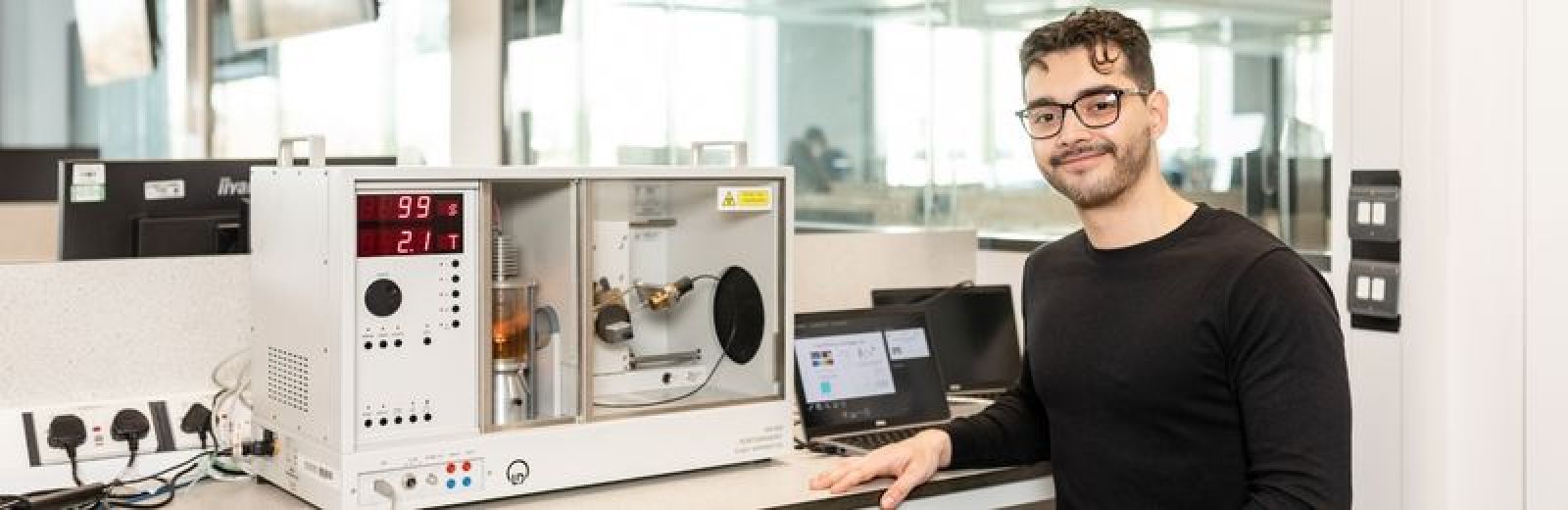
Physics is the most fundamental of the sciences, helping us understand how the universe works and driving the technological advances that shape modern society. From developing cancer treatments and artificial intelligence to exploring the origins of the universe, physicists make a significant impact across a wide range of industries, making physics a highly valued and versatile degree.
You’ll explore the fundamental laws of nature while learning from academics at the forefront of internationally recognised research. You'll develop a strong foundation in theoretical, computational and experimental physics, gaining the skills and experience needed to tackle complex scientific challenges and pursue a wide range of career opportunities.
As a physics student, you’ll be based in the Sir William Henry Bragg Building, home to specialist teaching laboratories, collaborative learning spaces and the Bragg Centre, where physicists, scientists and engineers work together to address global challenges in materials science and technology. Throughout your degree, you'll benefit from hands-on practical experience and, in your final year, contribute to a research project linked to our current research activity.
Our courses are shaped by the latest developments in physics, ensuring your studies reflect the rapidly evolving nature of the subject and its real-world applications. By the time you graduate, you'll have developed the analytical, technical and problem-solving skills that are highly sought after across sectors including research, technology, engineering, finance, data science and education.
Why study at Leeds:
- Study an Institute of Physics (IOP) accredited degree, providing a recognised pathway towards Chartered Physicists (CPhys) status and helping you build a strong foundation for a wide range of careers.
- Benefit from the flexibility to shape your degree, with opportunities to study abroad, undertake an industrial placement and potentially transfer to another physics programme as your interests develop.
- Develop the skills of a modern physicist through an integrated approach that combines physics, mathematics, computing, experimental work and independent research projects.
- Access outstanding facilities including specialist laboratories and teaching spaces right here on campus.
- Learn from world leading researchers and benefit from teaching shaped by the latest advances in physics.
Benefits of an integrated Masters
Learn more about what an integrated Masters is and how it can benefit your studies and boost your career.
Accreditation
This course is accredited by the Institute of Physics (IOP).
This integrated Masters degree guarantees you eligibility for full IOP membership and is accredited as fully meeting the academic requirement for registration as a registered scientist (RSci) or a chartered physicist (CPhys).

Course details and modules
We've designed this course to enable you to develop a strong foundation in physics alongside the mathematical, computational and experimental skills needed to become a physicist.
A common first year gives you the flexibility to explore a broad range of topics before choosing the degree pathway that best suits your interests.
As you progress, you’ll deepen your understanding of core physics and engage with topics shaped by our world leading research, while also exploring areas such as such as ethics, professional development and careers in physics.
In your final year, you’ll undertake an independent research project linked to current research activity and personalise your studies through a choice of specialist optional module topics.
Course Structure
Each academic year, you'll take a total of 120 credits.
The list shown below represents typical modules/components studied and may change from time to time. Read more in our terms and conditions.
Years 1 and 2
During Years 1 and 2, you'll build a strong foundation across core areas of physics, including quantum physics, particle physics, electrodynamics, thermal physics, classical mechanics, optics, solid-state physics, waves and physics for sustainable development. Mathematics and Python programming are integrated throughout the curriculum, helping you develop the analytical and computational skills used by modern physicists.
A common first year also provides flexibility, allowing you to transfer between Physics degree programmes up to the start of Year 2 as your interests develop.
Year 1
Compulsory modules
Our physics courses share a common core of 100 credits, taught across five modules that cover physics, mathematics, computing and essential practical skills.
Mechanics, Astrophysics and Relativity
You’ll learn how to describe motion through physical space. You'll also learn about using appropriate co-ordinate systems and the synergies between linear and circular motions. In special relativity, you'll extend your knowledge of co-ordinate systems to study motion as it appears to observers moving at different speeds. You'll also cover the theories originally developed by Einstein to describe this motion at speeds approaching the speed of light, and how the forces and energies of classical mechanics extend into the regime. In astrophysics, you'll learn how to apply basic physical principles to objects in the Universe and explore the fundamentals of radiation and how we observe these phenomena.
Thermodynamics, Waves and Electricity
You’ll explore the underpinning theories and concepts of thermodynamics and how they impact on the physical world, including in the energy sector. In Electricity, you’ll analyse and design simple electric circuits using fundamental circuit elements, such as resistors, capacitors and inductors.
Vibrations and waves occur in many different physical systems, from molecules to musical instruments to tectonic plates. Nevertheless, they can be described by a common mathematical approach, which this module provides. You’ll learn about oscillators, energy and resonance, energy/power transfer, reflection and transmission, impedance, superposition and interference.
Solid state, quantum mechanics and optics
You’ll cover the underpinning theories and concepts including mechanics of solids, Bohr atom, atomic electron states, elementary bonding, elasticity, photoelectric effect, Compton scattering, De Broglie relation, wave-particle duality, crystal structure and X-ray diffraction. You’ll also study the wave-like behaviour of light, mirrors, lenses, nonlinear optics and lasers.
Mathematical methods
You’ll develop the mathematical skills needed to describe physical processes, including vectors, unit vectors, scalar and vector products, calculus, summations, complex numbers, Fourier series, an introduction to Fourier transforms and the solution of second-order partial differential equations.
Computational and experimental physics
You’ll undertake a range of laboratory investigations throughout the year, designed to help you develop the skills and capabilities needed to be an experimental physicist. You’ll be introduced to programming using the Python computer programming language. You’ll also undertake tasks and assessments designed to improve your teamwork and presentation skills, as well as investigating physics career options and reflect on your own skills development.
Optional modules
You’ll choose up to 20 credits of the following optional modules or you may choose to combine one optional module with a discovery module.
Introduction to Nanotechnology (10 credits)
The smallest possible devices that can be fabricated are on the nanometre length scale. Miniaturisation of devices offers many new technological opportunities, which are only just starting to be implemented in our lives. The physical properties of nanomaterials differ from both the constituent atoms and the bulk material. These can be unique and surprising. This module aims to introduce the physics behind nanotechnology in a semi-quantitative manner, without requiring knowledge of quantum mechanics or Maxwell’s equations. To understand nanotechnology, we will describe the physics of atoms and molecules, before moving on to discuss nano and bulk properties. We will cover a number of nanotechnological applications currently adopted and on the horizon, including nanomedicine.
Planets and the Search for Life (10 credits)
Explore the multitude of planets that are currently being discovered around other stars and compare them to those in our solar system. This module will concentrate on the concepts involved and is non-mathematical, and therefore amenable to students of the arts, humanities and sciences. We will examine the origin and evolution of the solar system and how it is likely to have produced the range of planets, moons and minor bodies that we see today. This will be contrasted with the range of extra-solar planets, their detection, properties, and how they challenge our understanding of how planets are formed. Finally, the conditions for life to emerge will be discussed and the prospects and techniques for finding life elsewhere in the
Artificial Intelligence for scientists (10 credits)
This module introduces key concepts in artificial intelligence (AI), exploring the differences between narrow AI, which excels at specific tasks, and general AI, which aims to replicate human-like cognitive abilities. Through real-world examples from scientific applications, you’ll gain insight into the various classes of AI systems, such as expert systems, neural networks, and reinforcement learning models. The module emphasises how AI is transforming scientific fields, including physics and chemistry, and highlights the ethical considerations and limitations associated with AI technologies. By the end of the module, you’ll have a foundational understanding of AI systems and their applications across science.
Discovery modules (10 credits)
Discovery modules allow you to explore subjects beyond physics, develop new skills and pursue personal interests. Options range from languages and social sciences to technology, media and health.
You can also gain credit for real-world experiences including industry projects, enterprise activities, volunteering, leadership roles and climate action.
These experiences help you build a broader skill set, enhance your CV and demonstrate the adaptability employers increasingly value.
Year 2
Compulsory modules
In Year 2, you'll build on your first-year studies through integrated modules covering physics, mathematics, computing and practical skills, developing deeper subject knowledge and demonstrating your progress through coursework, projects, examinations and a skills portfolio.
Electromagnetism and Condensed Matter
You’ll learn how to use Maxwell's equations and to calculate fields in cases of simple symmetric geometry, calculate the force and energy in electric and magnetic fields, and discuss their derivation from the physical laws of electromagnetism. You’ll analyse simple AC circuits containing resistors, capacitors and inductors and apply logic principles to real-world scenarios in electronics and emerging technologies, developing the knowledge and skills needed to navigate the evolving landscape of electronic systems, from classical to quantum.
In Condensed Matter, you’ll learn about the use of the density of states to explain some of the differences between metals, semiconductors and insulators. You’ll also cover how to derive the free-electron density of states, perform straight-forward calculations based on the free-electron theory and how a periodic potential modifies the free-electron dispersion relation, solving problems on the transport properties of semiconductors, and calculating the magnetic properties of paramagnets and ferromagnets.
Statistical Mechanics, Quantum and Particle Physics
You’ll learn how to describe quantum systems using wavefunctions, operators and linear algebra and how to predict outcomes of measurements on quantum systems. You’ll also learn to solve the Schrodinger equation for simple model systems and understand the structure of atoms and molecules using the exclusion principle and spin. You’ll learn the concepts and applications of statistical mechanics, which are key to understanding the behaviour of small-particle systems.
In addition, you’ll learn about the structure of the atomic nucleus, predict various forms of radioactive decay and nuclear reactions, describe scattering processes between elementary particles and understand the key components of the Standard Model of particle physics.
Further Mathematical Methods
You’ll develop the mathematical language physicists use to describe real physical systems, from matrices and linear algebra for quantum states to ordinary and partial differential equations for motion, waves and fields. You’ll also use vector calculus, including div, grad and curl, and Fourier transforms to analyse fields, wave equations and other core problems across physics.
Professional Skills, Project Management and Data Science
You’ll strengthen your programming and data analysis skills by turning physical problems into short programs that read, manipulate, analyse and present data, building on the Python skills developed in Year 1. You’ll also develop the skills to communicate physics clearly in preparation for projects, dissertations and professional work after graduation.
Alongside this, you’ll explore physics career pathways and develop professional skills through activities such as CV writing, LinkedIn profile development, job applications and preparation for assessment centres and interviews.
Optional modules
You’ll choose one of the following optional modules.
Experimental Physics with Extended Investigation (40 credits)
Physics at Leeds is renowned for its strengths in Experimental Research. Through this module you will advance your laboratory and research skills using more advanced equipment and techniques. You will develop the skill to critically analyse the data you obtain to assess the accuracy and draw conclusions. In the extended investigation you build on your skills and working with other students to undertake an in-depth open-ended investigation building and developing an experiment that will prepare you for your final year research project
Experimental Physics and Astrophysics (40 credits)
This module consists of experimental activity that allows you to advance your key laboratory and research skills alongside gaining some specialist knowledge of Astrophysics. Using more advanced equipment you will develop the skill to critically analyse the data you obtain to assess the accuracy and draw conclusions. You will also have the opportunity to study some more Astrophysics, by studying one of the lecture topics on either Stellar Structure or High Energy Astrophysics.
Year 3
In your third year, your work will be closely linked to our current research, learning the skills required to allow you to conduct your own final year research project. You’ll extend your understanding of machine learning in both practical and theoretical modules. You’ll also have chance to choose from a range of specialist optional module topics.
Compulsory modules
Advanced Techniques in Experimental Physics (40 credits)
This module forms the bridge between the first and second year laboratory physics courses and the research focussed, open-ended projects of the 4th year Physics programmes. In this module, students carry out extended, open-ended studies using techniques common place in the experimental research programmes of the school of Physics to hone skills in experimentation, data handling and analysis.
Optional modules
You’ll choose four of the following optional modules.
Advanced Quantum Physics (20 credits)
You will study how quantum 'rules' work and apply them to real situations. You will also use perturbation theory to study more complex, and non-linear, problems and understand how to study electron spins using Pauli matrices.
Quantum Matter (20 credits)
Study how the theory of phonons (lattice vibrations) can be used to study condensed matter and advanced semiconducting devices. Delve into the physics of nanoscale structures and introductory superconductivity.
Advanced Optics with Photonics (20 credits)
An introduction to basic photonics, leading into the study of optical anisotropy, non-linear optics and lasers, and find out how to manipulate materials using optical tweezers.
Magnetism and Ferroic Materials (20 credits)
Magnetic and ferroelectric materials underpin much of modern technology and thus our everyday lives, from electric motors and dynamos to energy and data storage, sensors and computing. This course will show you the physics underpinning these materials and systems.
Theoretical Elementary Particle Physics (20 credits)
Gain an understanding of our current models for theoretical particle physics, including the use of symmetry and relativistic quantum mechanics in the Standard Model, as well as how to calculate complex interactions using Feynman diagrams.
Advanced Mechanics (20 credits)
Study how Lagrangian and Hamiltonian methods can be applied to complex advanced mechanical problems, and why symmetry and conservation laws are so closely interlinked.
Molecular Simulation with Machine Learning: Theory and Practice (20 credits)
The module will introduce the theory and practical implementation of Monte Carlo and Molecular Dynamics simulations of materials, including biomolecules, and will also provide practical experience of using standard software packages to perform these simulations on high-performance computing facilities.
Star and Planet Formation (20 credits)
You will study the physical processes underpinning the formation of stars and planets, learning how stars form, but also how exo-planets form around them.
Cosmology (20 credits)
Gain the fundamental knowledge for understanding the basis for both observational and theoretical cosmology, from the first 10-43 seconds through to the present day.
Physics in Schools (20 credits)
Learn about the UK education system, teaching methods for physics, and undertake a mini-placement in a local secondary school science department. This module is especially valuable if you are considering a career in teaching.
Group Innovation Project (20 credits)
Work as a team to create a business plan and presentation pitch for a new venture based on physics research. There is a strong focus on creating a business that will address one or more of the UN Sustainable Development Goals. This is an opportunity to be really creative!
Options from other schools (20 credits)
You can choose to study 20 credits of modules from other subject areas allowing you to explore topics such as medical imaging, nuclear technologies, atmospheric and climate science, oceanography, and the philosophical foundations of modern physics.
Year 4
Compulsory modules
Project (40 credits)
Your final-year project gives you the opportunity to undertake a substantial piece of independent research under the supervision of expert academic staff and as part of one of our six research groups. Whether your project is experimental, computational, theoretical or focused on physics education, you’ll develop and deliver your own programme of research, analyse and interpret your findings, and communicate your results through professional reports and presentations.
Along the way, you’ll develop valuable skills in research, project management, critical thinking and scientific communication, while contributing to cutting-edge physics research. For many students, this is one of the most rewarding parts of the degree, with some even seeing their work published in peer-reviewed scientific journals.
Optional modules
You’ll choose eight of the following optional modules.
Soft Matter Physics: Liquid Crystals (15 credits)
Soft matter physics and liquid crystals are important states of matter that have an intermediate order between the liquid and crystal solids. They are relevant to many aspects of science and technology, from display devices to biological. This module will provide you with the background physics behind the principal liquid crystal phases.
Quantum Field Theory (15 credits)
Learn how to explain and apply to simple problems all the basic principles, building blocks, tools and concepts of QFT.
Winds, Bubbles and Explosions (15 credits)
Massive stars inject radiative and mechanical energy into the interstellar medium via their intense photon fluxes, powerful winds, and SN explosions. This “feedback” is at least partially responsible for dispersing the molecular gas from massive star-forming regions. On larger scales, the energy injected from groups of massive stars powers galactic fountains and superwinds. This module covers the theory behind these processes and the necessary background to understand them.
Advanced Bionanophysics Research (15 credits)
Learn about and discuss current research topics in experimental bionanophysics. The module will have a strong emphasis on the emerging applications of bionanophysics and the development of new tools and technologies for biomedical and biomaterials applications.
Quantum Information Science and Technology (15 credits)
On completion of this module, you should be able to describe the applications and limitations of classical information theory and the processes of quantum communications. You’ll be able to solve numerical examples of problems in transmission of quantum information through noisy channels and explain, quantitatively, the fundamental processes of quantum entanglement. You'll also be able to describe the application of quantum measurements and entanglement to quantum key distribution and quantum metrology and appreciate the hardware and algorithmic requirements for quantum computation.
Current Research Topics in Physics (15 credits)
Attend research seminars given by internal and external speakers across a wide range of physics topics. This will allow you to critically analyse these results, applying your physics knowledge. You’ll also research and write about current research in physics using relevant online resources.
Physics of Biological Systems (15 credits)
This module illustrates through a set of examples at the forefront of the discipline how concepts from physics help understand how biological systems function. The range of systems sizes covered spans from molecules and their nanoscale assemblies to cells and tissues. These will be introduced at a level necessary to reveal salient physical phenomena at play and you’ll explore experimental techniques to analyse their physical properties. The physics of the systems will be treated quantitatively making use of mathematical techniques and physics concepts acquired in foundational physics courses.
Exoplanetary Systems (15 credits)
Explore observational techniques in the detection of exoplanets, the physics of exoplanet atmospheres and planet formation, and the principles of habitability. You’ll be taught the underlying theories and techniques and then work through several examples, learning how to apply the taught concepts to solve problems in this area.
Quantum Many-Body Physics (15 credits)
Build foundational knowledge in quantum many-body systems, based on the mathematical formalism of second quantisation and the ideas from quantum information such as entanglement. The module will take you to the cutting edge of research into quantum many-body systems, highlighting their fundamental role in condensed matter and high-energy physics, but also their promising applications in quantum computing.
Soft Matter Physics: Polymers, Colloids and Glasses (15 credits)
You'll explore and develop your understanding of the structure of polymers, dynamics and viscoelasticity of polymer melts and solutions, glass-formation in soft matter, colloids and colloidal interactions and phase separation in soft matter.
General Relativity (15 credits)
Learn how to utilise techniques appropriate to differential geometry for familiar problems from Special Relativity before moving on to the study of how these methods can be used to derive the optimal means of studying particle dynamics in a curved space-time, and how physical laws can be translated into the same framework. The module will conclude with a study of applications of general relativity including cosmology and black holes.
Superconductivity (15 credits)
Explore the phenomenological properties and theories of superconductivity, including the principal features of superconducting tunnel junctions and contacts. You’ll also build an understanding of superconductivity using appropriate mathematical tools.
Advanced Physics in Schools (15 credits)
Build your experience in teaching, whilst also using a critical eye to write a literature review of current issues in physics teaching. You’ll then deliver a presentation, with demonstration, to showcase a research topic adapted for teaching purposes.
Group Innovation Project in Sustainability (15 credits)
Learn about the UN’s Sustainable Development Goals, working in a team to develop a business plan around an idea for an enterprise based on current scientific research that will address these goals. The module will lead you through the various stages of setting up a new enterprise, from the inception and development of the idea itself, through preparation of a business plan and pitch to potential investors. Throughout the module, you’ll further develop your skills in teamwork, project and time management, commercial awareness and self-reflection while providing valuable insight into the commercial side of science.
Learning and teaching
Our integrated approach to teaching combines theoretical knowledge and practical experience, helping you develop the skills, knowledge and mindset needed to become a physicist.
You’ll learn through a variety of teaching methods, including lectures, workshops, small-group tutorials, laboratory classes, project work and computer-based learning.
In the first two years, our teaching is delivered through interactive in-person lectures, small group tutorials and larger workshops, where you’ll develop your problem-solving skills. In your final year, you’ll study more advanced topics led by academics whose teaching is informed by their specialist research expertise.
Practical and experimental work is a core part of the degree. It provides you with the opportunity to develop your verbal and written communication skills through performing experiments individually, and as part of a group. Computer programming is an integral part of physics, and during your first two years you'll gain programming experience using Python.
You'll be part of a supportive learning community from day one. Every student is assigned a personal tutor who will support their academic progress and transition to university life. In your first year, you'll meet regularly through weekly tutorials, helping you build connections with both staff and fellow students.
You'll also benefit from our peer-assisted learning scheme, where higher-year students share advice, academic support and insights into university life. Outside the classroom, you can get involved with the Physics Society, a student-run community offering guest lectures, trips and social events for students who share your interest in physics.
In addition to your studies, you’ll have the opportunity to apply to either undertake a year working in industry or studying abroad.
Purpose-built teaching facilities
You'll be based in the Sir William Henry Bragg Building – an impressive development bringing together our friendly, supportive and diverse community of students, researchers and academics to collaborate in the same modern space.
Explore more of our facilities through our 360 virtual experience.
Summer internships
During your time at Leeds, you’ll have the opportunity to apply for a paid summer internship, giving you the chance to get involved in research projects to advance your professional skills in research and experimentation.
Want to find out more? Check out what our recent students got up to on their summer internships.
On this course, you’ll be taught by our expert academics, from lecturers through to professors. You may also be taught by industry professionals with years of experience, as well as trained postgraduate researchers, connecting you to some of the brightest minds on campus.
Assessment
In this programme, we will utilise a variety of assessment methods, including written reports, open-book exams, online tests and presentations. In your final year, the programme features a research project, which emphasises open-ended investigations and includes written and verbal presentations.
Entry requirements
A-level: AAA including Physics and Mathematics.
Where an A Level science subject is taken, we require a pass in the practical science element, alongside the achievement of the A Level at the stated grade.
Extended Project Qualification (EPQ), International Project Qualification (IPQ): We recognise the value of these qualifications and the effort and enthusiasm that applicants put into them, and where an applicant offers an A in the EPQ, IPQ or ASCC we may make an offer of AAB at A-level including A in Physics and Mathematics.
GCSE: English Language grade 4 (C) or higher, or an equivalent English language qualification. We will accept Level 2 Functional Skills English instead of GCSE English.
Alternative qualifications
Access to HE Diploma
Overall pass of the Access to HE, with 45 credits at level 3. Of these 45 credits, 30 level 3 credits must be in Physics and Mathematics and must be passed with Distinction.
BTEC
BTEC qualifications in relevant disciplines are considered in combination with A Level Physics and Mathematics. Applicants should contact the School to discuss.
Cambridge Pre-U
D3 D3 M2 to include Physics and Mathematics.
International Baccalaureate
18 points at Higher Level to include 5 in Higher Level Physics and 5 in Higher Level Mathematics.
Irish Leaving Certificate (Higher Level)
H1, H2, H2, H2, H2, H2 including Physics and Mathematics.
Scottish Highers / Advanced Highers
AA at Advanced Higher in Physics and Mathematics with AABBB at Higher.
T-Levels
We do not accept T Levels as entry onto this course. You might be considered for entry to one of our foundation year courses.
Welsh Baccalaureate
Welsh Baccalaureate Advanced Skills Challenge Certificate: We will accept the Advanced Skills Challenge Certificate in lieu of a third A-Level at the same grade, assuming any subject specific requirements are met using alternative qualifications.
Read more about UK and Republic of Ireland accepted qualifications or contact the School’s Undergraduate Admissions Team.
Alternative entry
We’re committed to identifying the best possible applicants, regardless of personal circumstances or background.
Access to Leeds is a contextual admissions scheme which accepts applications from individuals who might be from low income households, in the first generation of their immediate family to apply to higher education, or have had their studies disrupted.
If you live in a neighbourhood where there is low participation in higher education, we may be able to give priority to your application.
Find out more about Access to Leeds and contextual admissions.
Typical Access to Leeds A Level offer: ABB including physics and mathematics and a pass in the Access to Leeds scheme.
Alternative Entry Scheme for Mature Students
If you are a mature applicant (over 21) and you don’t have the required A Levels or GCSE English and maths qualifications, you can complete our Alternative Entry Scheme (subject to meeting the eligibility criteria for the scheme). As part of this, you may be asked to take tests in English and maths and to write an essay.
Further information on the support available for mature students can be found at https://www.leeds.ac.uk/mature-students.
Foundation years
If you do not have the formal qualifications for immediate entry to one of our degrees, you may be able to progress through a foundation year. A Foundation Year is the first year of an extended degree. We’ve designed these courses for applicants whose backgrounds mean they are less likely to attend university and who don’t meet the typical entry requirements for an undergraduate degree.
We offer a Studies in Science with Foundation Year BSc for students without science and mathematics qualifications.
You could also study our Interdisciplinary Science with Foundation Year BSc which is for applicants whose background is less represented at university.
On successful completion of your foundation year, you will be able to progress onto your chosen course.
International
We accept a range of international equivalent qualifications. For more information, please contact the Admissions Team.
International foundation year
International students who do not meet the academic requirements for undergraduate study may be able to study the University of Leeds International Foundation Year. This gives you the opportunity to study on campus, be taught by University of Leeds academics and progress onto a wide range of Leeds undergraduate courses. Find out more about International Foundation Year programmes.
English language requirements
IELTS 6.0 overall, with no less than 5.5 in any one component. For other English qualifications, read English language equivalent qualifications.
Improve your English
If you're an international student and you don't meet the English language requirements for this programme, you may be able to study our undergraduate pre-sessional English course, to help improve your English language level.
Fees
UK: £10,050
International: £33,700 (per year)
The amount of tuition fees you pay is based on whether you are classified as a home (UK) or international student. Find out how we assess your fee status.
Tuition fees for UK students
Tuition fees for UK undergraduate students starting in 2027/28 are £10,050.
Subsequent years
The UK government sets the maximum tuition fee caps that universities can charge UK students. This means your tuition fee in future academic years will reflect any changes set by the government.
From 2028/29 onwards, tuition fees are likely to increase annually, at least in line with inflation, and may rise further if the government increases the fee cap.
Tuition fees for international students
The international fee applies for each year of full-time study and will remain the same for the duration of your course.
Read more about tuition fees.
Tuition fees for a study abroad or work placement year
If you take a study abroad or work placement year, you’ll pay a reduced tuition fee during this period. For more information, see Study abroad and work placement years on our tuition fees page.
Additional cost information
Whilst there are no compulsory additional costs, it would be helpful to bring your own calculator. You’ll have access to all the recommended texts and a vast supply of books and academic journals from the university libraries.
You’ll also have access to the extensive IT facilities on campus including 24/7 computer clusters with everything you need to complete your work.
However, you may wish to purchase your own books and/or computer.
There may be additional costs related to your course or programme of study, or related to being a student at the University of Leeds. Read more on our living costs and budgeting page.
Scholarships and financial support
If you have the talent and drive, we want you to be able to study with us, whatever your financial circumstances. There is help for students in the form of loans and non-repayable grants from the University and from the government. Learn more about undergraduate funding.
Scholarships are also available to help fund your degree. Find out more and check your eligibility below:
Applying
Apply to this course and check the deadline for applications through the UCAS website.
We may consider applications submitted after the deadline. Availability of courses in UCAS Extra will be detailed on UCAS at the appropriate stage in the cycle.
Admissions guidance
Read our admissions guidance about applying and writing your personal statement.
What happens after you’ve applied
You can keep up to date with the progress of your application through UCAS.
UCAS will notify you when we make a decision on your application. If you receive an offer, you can inform us of your decision to accept or decline your place through UCAS.
How long will it take to receive a decision
We typically receive a high number of applications to our courses. For applications submitted by the January UCAS deadline, UCAS asks universities to make decisions by mid-May at the latest.
Offer holder days
If you receive an offer from us, you’ll be invited to an offer holder event. This event is more in-depth than an open day. It gives you the chance to learn more about your course and get your questions answered by academic staff and students. Plus, you can explore our campus, facilities and accommodation.
International applicants
International students apply through UCAS in the same way as UK students.
We recommend that international students apply as early as possible to ensure that they have time to apply for their visa.
Read about visas, immigration and other information here.
If you’re unsure about the application process, contact the admissions team for help.
Academic Technology Approval Scheme (ATAS)
The UK Government’s Foreign and Commonwealth Office (FCO) operates a scheme called the Academic Technology Approval Scheme (ATAS). If you are an international (non-EU/EEA or Swiss citizen) applicant and require a student visa to study in the UK then you will need an ATAS certificate to study this course at the University of Leeds.
To apply for an ATAS certificate online, you will need your programme details and the relevant Common Aggregation Hierarchy (CAH) code and descriptor. For this course, the CAH code is: CAH07-01-01 and the descriptor is: Physics.
More information and details on how to apply for your ATAS certificate can be found at GOV.UK.
Admissions policy
University of Leeds Admissions Policy 2027
This course is taught by
School of Physics and Astronomy
Contact us
School of Physics and Astronomy Undergraduate Admissions Enquiries
Career opportunities
There are extensive employment opportunities in the field of physics across numerous industries, which is why physics graduates are in demand for some of the highest paid and most satisfying roles in employment.
Qualifying with a degree in physics from Leeds will set you up with the numerical, analytical and problem-solving skills and specialist subject knowledge needed to pursue an exciting career across a wide range of sectors, including:
- IT
- Engineering
- Finance (including Fintech)
- Medical Physics
- Patent Attorney
- Tech Consulting
- Aerospace
- Electronics
- Energy
- Teaching
- Environment
- Science Journalism
- Research
Throughout your course – especially in your final year research project – you'll have the chance to advance your knowledge and experience, whilst developing widely transferable skills desirable to employers including teamwork, independent research, analysis and communication.
Here’s an insight into the job roles some of our most recent physics graduates have obtained:
- Astrophysicist, NASA Goddard Space Flight Center
- Clinical Scientist, Christie Hospital NHS Trust
- Electronic Engineer, NASA
- IT Specialist, IBM
- Nuclear Engineer, Rolls Royce Submarines
- Nuclear Independent Oversight Inspector, Sellafield Limited
- Physicist, AMEC
- Radiographer, NHS
- Research Scientist, National Physical Laboratory
- Robotics Systems Engineer, Dyson
- Science Teacher
- Scientific Officer, Met. Office
- Systems Engineer, Boeing
- Thermo Fluid Engineer, Rolls-Royce
Read our alumni profiles to find out more about where our students are working.
Top 10 most targeted for 10+ years
by the UK's leading employers
Careers support
At Leeds, we help you to prepare for your future from day one. We have a wide range of careers resources — including our award-winning Employability Team who are in contact with many employers around the country and advertise placements and jobs. They are also on hand to provide guidance and support, ensuring you are prepared to take your next steps after graduation and get you where you want to be.
- Employability events — we run a full range of events including careers fairs in specialist areas and across broader industries — all with employers who are actively recruiting for roles.
- MyCareer system — on your course and after you graduate, you’ll have access to a dedicated careers portal where you can book appointments with our team, get information on careers and see job vacancies and upcoming events.
- Qualified careers consultants — gain guidance, support and information to help you choose a career path. You’ll have access to 1-2-1 meetings and events to learn how to find employers to target, write your CV and cover letter, research before interviews and brush up on your interview skills.
- Opportunities at Leeds — there are plenty of exciting opportunities offered by our Leeds University Union, including volunteering and over 300 clubs and societies to get involved in.
We’re also an active partner in the White Rose Industrial Physics Academy, where we hold the UK’s largest annual Physics Careers Fair, with employers looking exclusively for physicists.
Explore more about your employability opportunities at the University of Leeds.
You'll also have full access to the University’s Careers Centre, which is one of the largest in the country.
Study abroad and work placements
Study abroad
Studying abroad is a unique opportunity to explore the world, whilst gaining invaluable skills and experience that could enhance your future employability and career prospects too.
From Europe to Asia, the USA to Australasia, we have many University partners worldwide you can apply to, spanning across some of the most popular destinations for students.
This programme offers you the option to spend time abroad as an extra academic year and will extend your studies by 12 months.
Once you’ve successfully completed your year abroad, you'll be awarded the ‘international’ variant in your degree title which demonstrates your added experience to future employers.
Find out more about Study abroad.
Work placements
A placement year is a great way to help you decide on a career path when you graduate. You’ll develop your skills and gain a real insight into working life in a particular company or sector. It will also help you to stand out in a competitive graduate jobs market and improve your chances of securing the career you want.
Benefits of a work placement year:
- 100+ organisations to choose from, both in the UK and overseas
- Build industry contacts within your chosen field
- Our close industry links mean you’ll be in direct contact with potential employers
- Advance your experience and skills by putting the course teachings into practice
- Gain invaluable insight into working as a professional in this industry
- Improve your employability
If you decide to undertake a placement year, this will extend your period of study by 12 months and, on successful completion, you'll be awarded the ‘industrial’ variant in your degree title to demonstrate your added experience to future employers.
With the help and support of our dedicated Employability Team, you can find the right placement to suit you and your future career goals.
Here are some examples of placements our students have recently completed:
- RF, IT, Secure Networks & Communications 2021 Year in Industry, QinetiQ
- Industrial Placement - Technology Network Engineering, Vodafone Limited
- Pricing and Supply Chain Analyst, Solidigm
- QA Engineer, Elder Studios Ltd
- Software Engineer, Renishaw
Find out more about Industrial placements.